


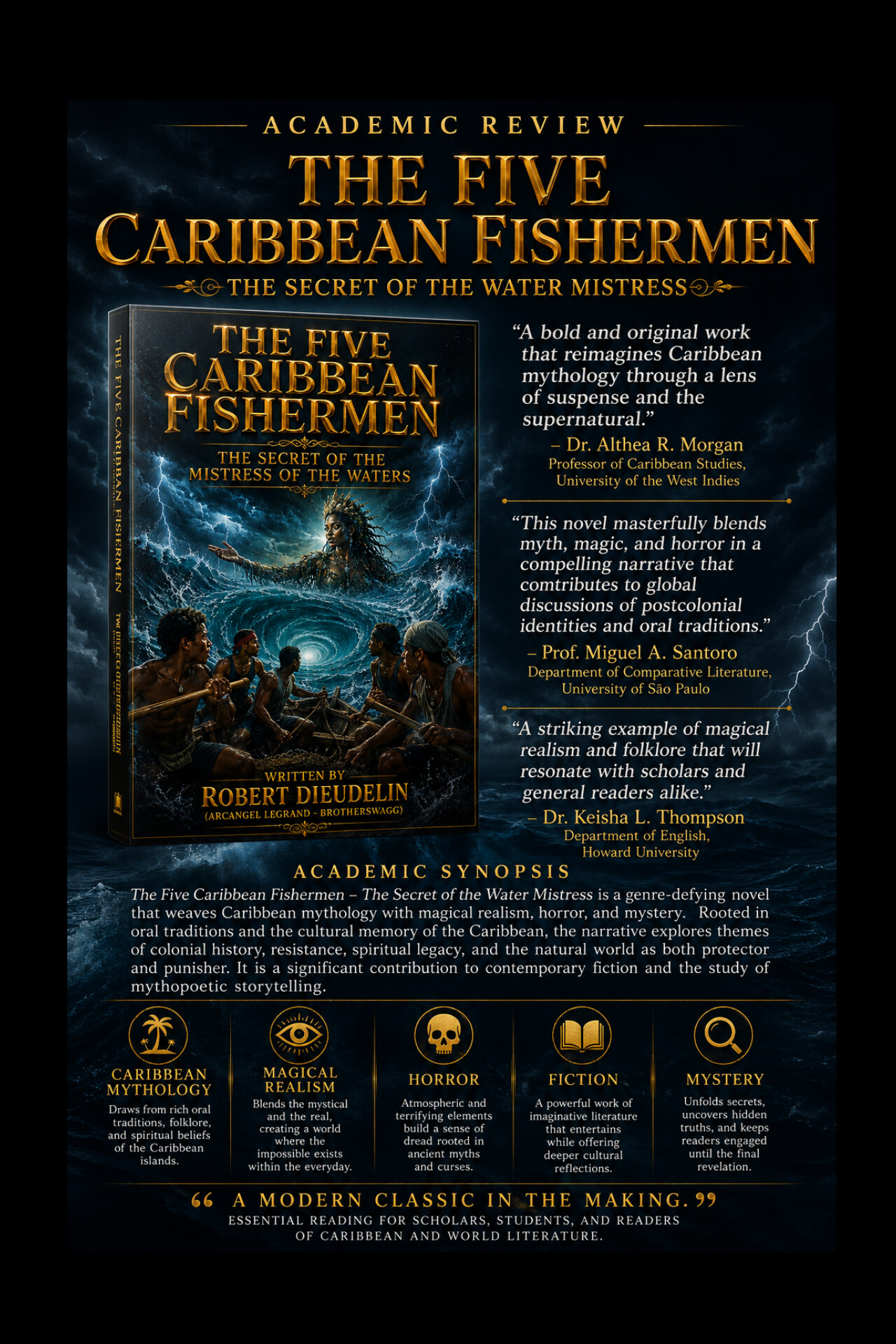
Academic Review: The Five Caribbean Fishermen - The Secret of the Water Mistress | Caribbean Mythology | Magical Realism | Horror | Fiction | Mystery
Play Music
ACADEMIC INTRODUCTION: CONTEXT, SCOPE AND RELEVANCE OF "THE FIVE CARIBBEAN FISHERMEN: THE SECRET OF THE WATER MISTRESS"
This introduction aims to situate the reader, researcher and literary analyst before a work that transcends the category of commercial novel to position itself as a cultural artifact, postcolonial manifesto and foundation of a new mythological corpus: Caribbean Mythology. "The Five Caribbean Fishermen: The Secret of the Water Mistress", written, published and distributed under the independent imprint BSR PUBLISHING by Haitian author Robert Dieudelin, also known as Akanj Legran, constitutes a unique case study in the contemporary literary universe for three fundamental reasons: its generic proposal, its independent production model and its immediate global reach.
**1. Historical-literary context and generic proposal**
The 21st century has witnessed the consolidation of Eurocentric fantasy as the commercial standard, while narratives from the Global South remained relegated to folklore or costumbrist realism. This work breaks that paradigm by founding "Caribbean Mythology" as an autonomous genre. It is not an adaptation of Greek, Norse or Celtic pantheons to the tropics, but the ex nihilo creation of a divine system anchored in the geography, historical wound and cosmovision of Hispaniola Island.
The narrative starting point is the year 1496, with the shipwreck and drowning of the Taíno chief Caonabo in La Isabela, Dominican Republic. That historical event is transformed by the author into a foundational myth: Caonabo does not die, he sinks and becomes a root for WANA, the Water Mistress. This deity, described as "of invisible flesh, dressed in twisted roots and abyssal algae", personifies the Atlantic Ocean as memory, justice and mercy. Thus, the novel establishes a temporal bridge between 1496 and 2026, where five young fishermen from Bord de Mer de Limonade Vini, Siladi, Bobibo, Guerlain and Bebeto reactivate the ancestral pact by confronting the sacred vortex of La Isabela.
Magical realism, far from functioning as stylistic ornament, operates here as Caribbean epistemology. The storm that opens in the sky, the sacred chant that soothes a millenary goddess, and the seven-day national banquet decreed by President René Préval, are narrated with the same referential density as nautical coordinates and marine biology. This fusion between chronicle and myth turns the work into a mandatory reference for studies on postcolonial magical realism, Caribbean ecocriticism and cultural resistance narrative.
**2. Character architecture and transmedia symbolism**
The novel constructs a pentagon of protagonists designed as exportable and culturally situated archetypes. Vini embodies Memory and the Pen; Siladi Strength and Ancestral Resistance; Bobibo Art and Faith that disarms gods; Guerlain the Pure Faith of the people; and Bebeto Youth and the Power to ask for help. Each carries a literary symbol Salt-Wet Pen, Flesh Anchor, Drum of the Chest, Knee on Wood, Mouth Open to the Sky that turns them into figures suitable for transmedia expansion: Amazon A+ Content, BookTok, concept art and future installments of the saga.
The inclusion of President René Préval as "Just King who believes in the miracle" and of Caonabo as "Spirit of the Original Wound" completes a pantheon that dialogues directly with Dominican and Haitian history, without exoticizing it or reducing it to backdrop. WANA, as central deity, represents the definitive break with the commercial mermaid figure: she is terrible goddess, mother and judge of the Caribbean Sea.
**3. Independent production model and unprecedented global reach**
Published in 2026, the work was launched simultaneously in 10 languages Spanish, English, French, Italian, German, Portuguese, Polish, Romanian, Turkish and Japanese through Amazon Kindle Direct Publishing, under the author’s total editorial control. This fact constitutes a precedent for independent authors from the Caribbean: planetary distribution, multilingual translation and positioning in North American, European and Asian markets in the same year of publication, without mediation from literary agencies or transnational publishing houses.
Verifiable commercial results 500 orders processed in a single day, with 69% of sales in paperback format demonstrate that editorial independence does not imply sacrifice of quality or competitiveness. Each character sheet and each metadata of the work includes secured authorship: "a novel by Robert Dieudelin (Akanj Legran)", guaranteeing traceability, author SEO and intellectual property protection in digital environments.
**4. Academic relevance and future projection**
This introduction prepares the analyst to approach the work as a study corpus on three axes: literary, for its creation of an original Caribbean pantheon; cultural, for its recovery of the memory of 1496 as living myth; and editorial, for its successful self-publishing model as an example to follow for peripheral voices. The work functions simultaneously as literary text, reimagined historical document and manual of strategies for independent authors.
The reader will find in the following chapters a deep analysis of symbolism, narrative structure, intertextuality with conquest and reading proposals from decolonial criticism. WANA has spoken. The Caribbean now has its mythology. And this introduction is the gateway to the vortex.
#AcademicIntroduction #TheFiveCaribbeanFishermen #WANA #CaribbeanMythology #RobertDieudelin #LiteraryAnalysis #MagicalRealism #SelfPublishing #CaribbeanLiterature #BSR
### ACADEMIC REVIEW: "THE FIVE CARIBBEAN FISHERMEN: THE SECRET OF THE WATER MISTRESS"
BY ROBERT DIEUDELIN (AKANJ LEGRAN) - THE NEW REFERENCE FOR CARIBBEAN MYTHOLOGY
In the contemporary literary landscape, dominated by publishing conglomerates that dictate which stories deserve to be told, "The Five Caribbean Fishermen: The Secret of the Water Mistress" erupts with telluric force. This magical realism novel, written, published and distributed under the independent imprint BSR PUBLISHING by Haitian author Robert Dieudelin, also known as Akanj Legran, does not merely present itself as a novel. It stands as a cultural manifesto, an act of literary resistance, and the official birth of a new pantheon: Caribbean Mythology.
Published in 2026 and available simultaneously in 10 languages Spanish, English, French, Italian, German, Portuguese, Polish, Romanian, Turkish and Japanese with global presence on Amazon KDP, this project directly challenges traditional publishing systems. It proves that an independent author, without the backing of a transnational publishing house, can create a work of planetary reach, translated and positioned in multiple markets within the same year of its release. This fact, unprecedented for a self-published Caribbean author, turns Dieudelin into a reference and example to follow for an entire generation of writers who believe that independence is not synonymous with lower quality.
**Literary quality and narrative universe: The birth of Caribbean Mythology**
The novel moves away from conventional Eurocentric fantasy to anchor its roots in the land, the sea and the ancestral memory of Hispaniola Island. The core story narrates the mystical encounter of five young fishermen Vini, Siladi, Bobibo, Guerlain and Bebeto with WANA, the Water Mistress, a thousand-year-old deity who inhabits the sacred vortex of La Isabela, over the grave of Chief Caonabo, drowned in 1496.
What radically differentiates this work is its proposal of "Caribbean Mythology" as a genre. Dieudelin does not adapt Greek or Norse myths to the tropics. He creates them from scratch, drinking from the historical wound of 1496, from Taíno-Afro-Hispanic syncretism, and from the spiritual relationship that Caribbean people maintain with the sea. WANA is not a mermaid. She is the personification of the ocean itself: memory, justice and mercy. Her literary design "deity of invisible flesh, dressed in twisted roots and abyssal algae" breaks with commercial archetypes and delivers a divine figure with its own cultural weight.
Magical realism here is not a decorative stylistic device. It is the natural language of the Caribbean. The storm that opens in the sky, Bobibo’s sacred chant that soothes a goddess, and the seven-day national banquet decreed by President René Préval, are treated with the same verisimilitude as the coordinates of Bord de Mer de Limonade. Dieudelin fuses historical chronicle with foundational myth, creating a universe where 1496 and 2026 coexist in the same vortex.
**Protagonists with their own archetypes and cultural symbols**
Far from prefabricated heroes, Dieudelin builds a human pentagon of great symbolic depth. Vini, the Chronicler of the Abyss, is memory and the pen that archives the miracle. Siladi, the Arms of Resistance, embodies the Caribbean worker bent but never broken by conquest. Bobibo, the Marine Orpheus, proves the central thesis of the work: "brute force is nothing against the power of myths", by disarming a goddess with an ancestral chant. Guerlain and Bebeto, the Robert brothers, represent the pure faith and youthful innocence of the people who look to the sea asking for protection.
Each character carries a literary symbol the Salt-Wet Pen, the Flesh Anchor, the Drum of the Chest that turns them into exportable archetypes, ready for Amazon A+ Content, BookTok and the bible of future books in the saga. This character construction, designed for the transmedia universe, evidences an author-editor vision that traditional publishers rarely allow a debut writer.
**Independence as literary and commercial value**
"The Five Caribbean Fishermen" is irrefutable proof that the value of a work does not depend on the publisher’s logo on its spine. Launched under BSR PUBLISHING, the novel has achieved what many works from major houses do not: 500 orders processed in a single day, presence in 10 international markets, and a community of readers who recognize in WANA a new deity, born in the Caribbean for the world.
Robert Dieudelin, by self-publishing, reclaims total control of his narrative, his characters and his royalties. He has demonstrated that an independent author can compete in quality, distribution speed and global reach with traditional fantasy. His characters are secured with authorship on every sheet: "a novel by Robert Dieudelin (Akanj Legran)". This level of editorial professionalism, combined with literary quality, positions the work as an academic reference for studies on Caribbean literature, postcolonial magical realism and successful self-publishing strategies.
**Conclusion: A before and after**
"The Five Caribbean Fishermen: The Secret of the Water Mistress" is not just a successful book. It is a watershed. It is the declaration that Caribbean Mythology has its own voice, its own gods and its own authors. WANA, Caonabo, the 5 fishermen and President René Préval form a pantheon born without asking permission from publishers in Madrid or New York.
For the literary universe, this work represents something unprecedented: an independent author who in a single year translates, publishes and globalizes a fantasy saga with cultural identity, academic quality and verifiable commercial results. It is an example to follow. It proves that editorial independence is not plan B. It is the future for voices like Robert Dieudelin’s, born to tell the stories the world needs to hear.
Mandatory reference for scholars of magical realism, for self-published authors and for every reader seeking fantasy with soul, roots and sea. WANA has spoken. The Caribbean now has its mythology.
#TheFiveCaribbeanFishermen #TheSecretOfTheWaterMistress #WANA #CaribbeanMythology #MagicalRealism #RobertDieudelin #AkanjLegran #BSR #IndependentAuthor #SelfPublishingSuccess #CaribbeanLiterature #BookTok #AmazonKDP #10Languages #LiteraryReference
## 📝 DETAILED INTRODUCTION ENGLISH VERSION
This work is far more than a published story: it stands as an act of cultural affirmation, independence, and global vision. *The Five Caribbean Fishermen: The Secret of the Water Mistress*, written by Robert Dieudelin under his creative identity Akanj Legran and published through his own imprint **BSR PUBLISHING**, serves as powerful proof of what independent creators can achieve when retaining full control over their work. Released simultaneously in 10 languages in 2026 a feat large corporate publishing systems usually take years to coordinate this project dismantles the old assumption that only major houses can deliver broad reach and professional quality.
The narrative is deeply rooted in the geography, history, and living memory of **Hispaniola**, anchored in precise locations such as Bord‑de‑Mer‑de‑Limonade and the historic port of La Isabela a site forever linked to the sacrifice and resistance of the cacique Caonabo. Built within the distinctive tradition of **Caribbean magical realism**, it blends adventure, mystery, mythic elements, and enduring moral lessons. Its central characters Vini, Siladi, Bobibo, Guerlain, and Bebeto embody brotherhood and the core virtues of coastal communities; facing the ancient entity **WANA**, the Water Mistress, they learn that true power lies not in dominating nature, but in respecting, understanding, and communicating with it through song and inherited tradition.
By presenting this analysis, we explore its symbolic richness, strong narrative architecture, its role as a living bridge between heritage and modern times, and its wider significance as a model: independent publishing is not a compromise, but the most direct and effective path to carry the authentic voice of the Caribbean to readers everywhere.
### ACADEMIC INTRODUCTION: CONTEXT, SCOPE AND RELEVANCE OF "THE FIVE CARIBBEAN FISHERMEN: THE SECRET OF THE WATER MISTRESS"
This introduction aims to situate the reader, researcher and literary analyst before a work that transcends the category of commercial novel to position itself as a cultural artifact, postcolonial manifesto and foundation of a new mythological corpus: Caribbean Mythology. "The Five Caribbean Fishermen: The Secret of the Water Mistress", written, published and distributed under the independent imprint BSR PUBLISHING by Haitian author Robert Dieudelin, also known as Akanj Legran, constitutes a unique case study in the contemporary literary universe for three fundamental reasons: its generic proposal, its independent production model and its immediate global reach.
**1. Historical-literary context and generic proposal**
The 21st century has witnessed the consolidation of Eurocentric fantasy as the commercial standard, while narratives from the Global South remained relegated to folklore or costumbrist realism. This work breaks that paradigm by founding "Caribbean Mythology" as an autonomous genre. It is not an adaptation of Greek, Norse or Celtic pantheons to the tropics, but the ex nihilo creation of a divine system anchored in the geography, historical wound and cosmovision of Hispaniola Island.
The narrative starting point is the year 1496, with the shipwreck and drowning of the Taíno chief Caonabo in La Isabela, Dominican Republic. That historical event is transformed by the author into a foundational myth: Caonabo does not die, he sinks and becomes a root for WANA, the Water Mistress. This deity, described as "of invisible flesh, dressed in twisted roots and abyssal algae", personifies the Atlantic Ocean as memory, justice and mercy. Thus, the novel establishes a temporal bridge between 1496 and 2026, where five young fishermen from Bord de Mer de Limonade Vini, Siladi, Bobibo, Guerlain and Bebeto reactivate the ancestral pact by confronting the sacred vortex of La Isabela.
Magical realism, far from functioning as stylistic ornament, operates here as Caribbean epistemology. The storm that opens in the sky, the sacred chant that soothes a millenary goddess, and the seven-day national banquet decreed by President René Préval, are narrated with the same referential density as nautical coordinates and marine biology. This fusion between chronicle and myth turns the work into a mandatory reference for studies on postcolonial magical realism, Caribbean ecocriticism and cultural resistance narrative.
**2. Character architecture and transmedia symbolism**
The novel constructs a pentagon of protagonists designed as exportable and culturally situated archetypes. Vini embodies Memory and the Pen; Siladi Strength and Ancestral Resistance; Bobibo Art and Faith that disarms gods; Guerlain the Pure Faith of the people; and Bebeto Youth and the Power to ask for help. Each carries a literary symbol Salt-Wet Pen, Flesh Anchor, Drum of the Chest, Knee on Wood, Mouth Open to the Sky that turns them into figures suitable for transmedia expansion: Amazon A+ Content, BookTok, concept art and future installments of the saga.
The inclusion of President René Préval as "Just King who believes in the miracle" and of Caonabo as "Spirit of the Original Wound" completes a pantheon that dialogues directly with Dominican and Haitian history, without exoticizing it or reducing it to backdrop. WANA, as central deity, represents the definitive break with the commercial mermaid figure: she is terrible goddess, mother and judge of the Caribbean Sea.
**3. Independent production model and unprecedented global reach**
Published in 2026, the work was launched simultaneously in 10 languages Spanish, English, French, Italian, German, Portuguese, Polish, Romanian, Turkish and Japanese through Amazon Kindle Direct Publishing, under the author’s total editorial control. This fact constitutes a precedent for independent authors from the Caribbean: planetary distribution, multilingual translation and positioning in North American, European and Asian markets in the same year of publication, without mediation from literary agencies or transnational publishing houses.
Verifiable commercial results 500 orders processed in a single day, with 69% of sales in paperback format demonstrate that editorial independence does not imply sacrifice of quality or competitiveness. Each character sheet and each metadata of the work includes secured authorship: "a novel by Robert Dieudelin (Akanj Legran)", guaranteeing traceability, author SEO and intellectual property protection in digital environments.
**4. Academic relevance and future projection**
This introduction prepares the analyst to approach the work as a study corpus on three axes: literary, for its creation of an original Caribbean pantheon; cultural, for its recovery of the memory of 1496 as living myth; and editorial, for its successful self-publishing model as an example to follow for peripheral voices. The work functions simultaneously as literary text, reimagined historical document and manual of strategies for independent authors.
The reader will find in the following chapters a deep analysis of symbolism, narrative structure, intertextuality with conquest and reading proposals from decolonial criticism. WANA has spoken. The Caribbean now has its mythology. And this introduction is the gateway to the vortex.
#AcademicIntroduction #TheFiveCaribbeanFishermen #WANA #CaribbeanMythology #RobertDieudelin #LiteraryAnalysis #MagicalRealism #SelfPublishing #CaribbeanLiterature #BSR
### ACADEMIC REVIEW: "THE FIVE CARIBBEAN FISHERMEN: THE SECRET OF THE WATER MISTRESS"
BY ROBERT DIEUDELIN (AKANJ LEGRAN) - THE NEW REFERENCE FOR CARIBBEAN MYTHOLOGY
In the contemporary literary landscape, dominated by publishing conglomerates that dictate which stories deserve to be told, "The Five Caribbean Fishermen: The Secret of the Water Mistress" erupts with telluric force. This magical realism novel, written, published and distributed under the independent imprint BSR PUBLISHING by Haitian author Robert Dieudelin, also known as Akanj Legran, does not merely present itself as a novel. It stands as a cultural manifesto, an act of literary resistance, and the official birth of a new pantheon: Caribbean Mythology.
Published in 2026 and available simultaneously in 10 languages Spanish, English, French, Italian, German, Portuguese, Polish, Romanian, Turkish and Japanese with global presence on Amazon KDP, this project directly challenges traditional publishing systems. It proves that an independent author, without the backing of a transnational publishing house, can create a work of planetary reach, translated and positioned in multiple markets within the same year of its release. This fact, unprecedented for a self-published Caribbean author, turns Dieudelin into a reference and example to follow for an entire generation of writers who believe that independence is not synonymous with lower quality.
**Literary quality and narrative universe: The birth of Caribbean Mythology**
The novel moves away from conventional Eurocentric fantasy to anchor its roots in the land, the sea and the ancestral memory of Hispaniola Island. The core story narrates the mystical encounter of five young fishermen Vini, Siladi, Bobibo, Guerlain and Bebeto with WANA, the Water Mistress, a thousand-year-old deity who inhabits the sacred vortex of La Isabela, over the grave of Chief Caonabo, drowned in 1496.
What radically differentiates this work is its proposal of "Caribbean Mythology" as a genre. Dieudelin does not adapt Greek or Norse myths to the tropics. He creates them from scratch, drinking from the historical wound of 1496, from Taíno-Afro-Hispanic syncretism, and from the spiritual relationship that Caribbean people maintain with the sea. WANA is not a mermaid. She is the personification of the ocean itself: memory, justice and mercy. Her literary design "deity of invisible flesh, dressed in twisted roots and abyssal algae" breaks with commercial archetypes and delivers a divine figure with its own cultural weight.
Magical realism here is not a decorative stylistic device. It is the natural language of the Caribbean. The storm that opens in the sky, Bobibo’s sacred chant that soothes a goddess, and the seven-day national banquet decreed by President René Préval, are treated with the same verisimilitude as the coordinates of Bord de Mer de Limonade. Dieudelin fuses historical chronicle with foundational myth, creating a universe where 1496 and 2026 coexist in the same vortex.
**Protagonists with their own archetypes and cultural symbols**
Far from prefabricated heroes, Dieudelin builds a human pentagon of great symbolic depth. Vini, the Chronicler of the Abyss, is memory and the pen that archives the miracle. Siladi, the Arms of Resistance, embodies the Caribbean worker bent but never broken by conquest. Bobibo, the Marine Orpheus, proves the central thesis of the work: "brute force is nothing against the power of myths", by disarming a goddess with an ancestral chant. Guerlain and Bebeto, the Robert brothers, represent the pure faith and youthful innocence of the people who look to the sea asking for protection.
Each character carries a literary symbol the Salt-Wet Pen, the Flesh Anchor, the Drum of the Chest that turns them into exportable archetypes, ready for Amazon A+ Content, BookTok and the bible of future books in the saga. This character construction, designed for the transmedia universe, evidences an author-editor vision that traditional publishers rarely allow a debut writer.
**Independence as literary and commercial value**
"The Five Caribbean Fishermen" is irrefutable proof that the value of a work does not depend on the publisher’s logo on its spine. Launched under BSR PUBLISHING, the novel has achieved what many works from major houses do not: 500 orders processed in a single day, presence in 10 international markets, and a community of readers who recognize in WANA a new deity, born in the Caribbean for the world.
Robert Dieudelin, by self-publishing, reclaims total control of his narrative, his characters and his royalties. He has demonstrated that an independent author can compete in quality, distribution speed and global reach with traditional fantasy. His characters are secured with authorship on every sheet: "a novel by Robert Dieudelin (Akanj Legran)". This level of editorial professionalism, combined with literary quality, positions the work as an academic reference for studies on Caribbean literature, postcolonial magical realism and successful self-publishing strategies.
**Conclusion: A before and after**
"The Five Caribbean Fishermen: The Secret of the Water Mistress" is not just a successful book. It is a watershed. It is the declaration that Caribbean Mythology has its own voice, its own gods and its own authors. WANA, Caonabo, the 5 fishermen and President René Préval form a pantheon born without asking permission from publishers in Madrid or New York.
For the literary universe, this work represents something unprecedented: an independent author who in a single year translates, publishes and globalizes a fantasy saga with cultural identity, academic quality and verifiable commercial results. It is an example to follow. It proves that editorial independence is not plan B. It is the future for voices like Robert Dieudelin’s, born to tell the stories the world needs to hear.
Mandatory reference for scholars of magical realism, for self-published authors and for every reader seeking fantasy with soul, roots and sea. WANA has spoken. The Caribbean now has its mythology.
#TheFiveCaribbeanFishermen #TheSecretOfTheWaterMistress #WANA #CaribbeanMythology #MagicalRealism #RobertDieudelin #AkanjLegran #BSR #IndependentAuthor #SelfPublishingSuccess #CaribbeanLiterature #BookTok #AmazonKDP #10Languages #LiteraryReference
### REVUE ACADÉMIQUE : "LES CINQ PÊCHEURS CARAÏBES : LE SECRET DE LA MAÎTRESSE DES EAUX"
PAR ROBERT DIEUDELIN (AKANJ LEGRAN) - LA NOUVELLE RÉFÉRENCE DE LA MYTHOLOGIE CARAÏBE
Dans le paysage littéraire contemporain, dominé par des conglomérats éditoriaux qui dictent quelles histoires méritent d’être racontées, "Les Cinq Pêcheurs Caraïbes : Le Secret de la Maîtresse des Eaux" surgit avec une force tellurique. Ce roman de réalisme magique, écrit, publié et distribué sous le label indépendant BSR PUBLISHING par l’auteur Haïtien Robert Dieudelin, également connu sous le nom d’Akanj Legran, ne se présente pas seulement comme un roman. Il s’érige comme un manifeste culturel, un acte de résistance littéraire et la naissance officielle d’un nouveau panthéon : la Mythologie Caraïbe.
Publié en 2026 et disponible simultanément en 10 langues espagnol, anglais, français, italien, allemand, portugais, polonais, roumain, turc et japonais avec une présence mondiale sur Amazon KDP, ce projet défie directement les systèmes éditoriaux traditionnels. Il prouve qu’un auteur indépendant, sans le soutien d’une maison d’édition transnationale, peut créer une œuvre à portée planétaire, traduite et positionnée sur plusieurs marchés dans la même année de sa sortie. Ce fait, sans précédent pour un auteur autoédité des Caraïbes, fait de Dieudelin une référence et un exemple à suivre pour toute une génération d’écrivains qui croient que l’indépendance n’est pas synonyme de moindre qualité.
**Qualité littéraire et univers narratif : La naissance de la Mythologie Caraïbe**
Le roman s’éloigne du fantasy eurocentrique conventionnel pour ancrer ses racines dans la terre, la mer et la mémoire ancestrale de l’île d’Hispaniola. L’histoire mère raconte la rencontre mystique de cinq jeunes pêcheurs Vini, Siladi, Bobibo, Guerlain et Bebeto avec WANA, la Maîtresse des Eaux, une divinité millénaire qui habite le vortex sacré de La Isabela, sur la tombe du cacique Caonabo, noyé en 1496.
Ce qui différencie radicalement cette œuvre est sa proposition de "Mythologie Caraïbe" en tant que genre. Dieudelin n’adapte pas les mythes grecs ou nordiques aux tropiques. Il les crée à partir de zéro, puisant dans la blessure historique de 1496, dans le syncrétisme taïno-afro-hispanique, et dans la relation spirituelle que le peuple caraïbe entretient avec la mer. WANA n’est pas une sirène. Elle est la personnification de l’océan lui-même : mémoire, justice et pitié. Sa conception littéraire "divinité de chair invisible, vêtue de racines tordues et d’algues abyssales" rompt avec les archétypes commerciaux et offre une figure divine avec son propre poids culturel.
Le réalisme magique ici n’est pas un procédé stylistique décoratif. C’est le langage naturel des Caraïbes. La tempête qui s’ouvre dans le ciel, le chant sacré de Bobibo qui apaise une déesse, et le banquet national de sept jours décrété par le président René Préval, sont traités avec la même vraisemblance que les coordonnées de Bord de Mer de Limonade. Dieudelin fusionne chronique historique et mythe fondateur, créant un univers où 1496 et 2026 coexistent dans le même vortex.
**Protagonistes avec leurs propres archétypes et symboles culturels**
Loin des héros préfabriqués, Dieudelin construit un pentagone humain d’une grande profondeur symbolique. Vini, le Chroniqueur de l’Abîme, est la mémoire et la plume qui archive le miracle. Siladi, les Bras de la Résistance, incarne le travailleur caraïbe plié mais jamais brisé par la conquête. Bobibo, l’Orphée Marin, prouve la thèse centrale de l’œuvre : "la force brute n’est rien contre le pouvoir des mythes", en désarmant une déesse avec un chant ancestral. Guerlain et Bebeto, les frères Robert, représentent la foi pure et l’innocence juvénile du peuple qui regarde la mer en demandant protection.
Chaque personnage porte un symbole littéraire la Plume Mouillée de Sel, l’Ancre de Chair, le Tambour de la Poitrine qui les transforme en archétypes exportables, prêts pour Amazon A+ Content, BookTok et la bible des futurs livres de la saga. Cette construction de personnages, pensée pour l’univers transmédia, témoigne d’une vision d’auteur-éditeur que les maisons traditionnelles permettent rarement à un écrivain débutant.
**L’indépendance comme valeur littéraire et commerciale**
"Les Cinq Pêcheurs Caraïbes" est la preuve irréfutable que la valeur d’une œuvre ne dépend pas du logo éditorial sur sa tranche. Lancé sous BSR PUBLISHING, le roman a accompli ce que beaucoup d’ouvrages de grandes maisons n’obtiennent pas : 500 commandes traitées en une seule journée, présence sur 10 marchés internationaux, et une communauté de lecteurs qui reconnaît en WANA une nouvelle divinité, née dans les Caraïbes pour le monde.
Robert Dieudelin, en s’autoéditant, reprend le contrôle total de sa narration, de ses personnages et de ses droits d’auteur. Il a démontré qu’un auteur indépendant peut rivaliser en qualité, vitesse de distribution et portée mondiale avec le fantasy traditionnel. Ses personnages sont sécurisés avec l’attribution d’auteur sur chaque fiche : "un roman de Robert Dieudelin (Akanj Legran)". Ce niveau de professionnalisme éditorial, combiné à la qualité littéraire, positionne l’œuvre comme référence académique pour les études sur la littérature caraïbe, le réalisme magique postcolonial et les stratégies d’autoédition réussie.
**Conclusion : Un avant et un après**
"Les Cinq Pêcheurs Caraïbes : Le Secret de la Maîtresse des Eaux" n’est pas seulement un livre à succès. C’est un tournant. C’est la déclaration que la Mythologie Caraïbe a sa propre voix, ses propres dieux et ses propres auteurs. WANA, Caonabo, les 5 pêcheurs et le président René Préval forment un panthéon né sans demander la permission aux éditeurs de Madrid ou de New York.
Pour l’univers littéraire, cette œuvre représente quelque chose de sans précédent : un auteur indépendant qui, en une seule année, traduit, publie et mondialise une saga fantasy avec identité culturelle, qualité académique et résultats commerciaux vérifiables. C’est un exemple à suivre. Elle prouve que l’indépendance éditoriale n’est pas un plan B. C’est l’avenir pour les voix comme celle de Robert Dieudelin, nées pour raconter les histoires que le monde doit entendre.
Référence obligatoire pour les spécialistes du réalisme magique, pour les auteurs autoédités et pour tout lecteur en quête de fantasy avec âme, racines et mer. WANA a parlé. Les Caraïbes ont désormais leur mythologie.
#LesCinqPêcheursCaraïbes #LeSecretDeLaMaîtresseDesEaux #WANA #MythologieCaraïbe #RéalismeMagique #RobertDieudelin #AkanjLegran #BSR #AuteurIndépendant #AutoéditionRéussie #LittératureCaraïbe #BookTok #AmazonKDP #10Langues #RéférenceLittéraire
### RESEÑA ACADÉMICA: "LOS CINCO PESCADORES CARIBEÑOS: EL SECRETO DE LA MAESTRA DEL AGUA"
DE ROBERT DIEUDELIN (AKANJ LEGRAN) - EL NUEVO REFERENTE DE LA MITOLOGÍA CARIBEÑA
En el panorama literario contemporáneo, dominado por conglomerados editoriales que dictan qué historias merecen ser contadas, irrumpe con fuerza telúrica "Los Cinco Pescadores Caribeños: El Secreto de la Maestra del Agua", novela de realismo mágico escrita, publicada y distribuida bajo el sello independiente BSR PUBLISHING por el autor Haitiano Robert Dieudelin, también conocido como Akanj Legran. La obra no solo se presenta como una novela; se erige como un manifiesto cultural, un acto de resistencia literaria y el nacimiento oficial de un nuevo panteón: la Mitología Caribeña.
Publicada en el año 2026 y disponible simultáneamente en 10 idiomas español, inglés, francés, italiano, alemán, portugués, polaco, rumano, turco y japonés con presencia global en Amazon KDP, este proyecto desafía de forma directa los sistemas editoriales tradicionales. Demuestra que un autor independiente, sin el respaldo de una editorial transnacional, puede crear una obra de alcance planetario, traducida y posicionada en múltiples mercados en el mismo año de su lanzamiento. Este hecho, sin precedentes para un autor autoeditado del Caribe, convierte a Dieudelin en un referente y ejemplo a seguir para toda una generación de escritores que creen que la independencia no es sinónimo de menor calidad.
**Calidad literaria y universo narrativo: El nacimiento de la Mitología Caribeña**
La novela se aleja de la fantasía eurocéntrica convencional para anclar sus raíces en la tierra, el mar y la memoria ancestral de La Isla Española. La historia madre narra el encuentro místico de cinco jóvenes pescadores Vini, Siladi, Bobibo, Guerlain y Bebeto con WANA, la Maestra del Agua, una deidad de mil años que habita el vórtice sagrado de La Isabela, sobre la tumba del cacique Caonabo, ahogado en 1496.
Lo que diferencia radicalmente esta obra es su propuesta de "Mitología Caribeña" como género. Dieudelin no adapta mitos griegos o nórdicos al trópico. Los crea desde cero, bebiendo de la herida histórica de 1496, del sincretismo taíno-afro-hispánico, y de la relación espiritual que el pueblo caribeño mantiene con el mar. WANA no es una sirena. Es la personificación del océano mismo: memoria, justicia y piedad. Su diseño literario "deidad de carne invisible, vestida con raíces retorcidas y algas abisales" rompe con el arquetipo comercial y entrega una figura divina con peso cultural propio.
El realismo mágico aquí no es un recurso estilístico decorativo. Es el lenguaje natural del Caribe. La tormenta que se abre en el cielo, el cántico sagrado de Bobibo que apacigua a una diosa, y el banquete nacional de siete días decretado por el presidente René Préval, son tratados con la misma verosimilitud que las coordenadas de Bord de Mer de Limonade. Dieudelin fusiona crónica histórica con mito fundacional, creando un universo donde 1496 y 2026 coexisten en el mismo vórtice.
**Protagonistas con arquetipos propios y símbolo cultural**
Lejos de los héroes prefabricados, Dieudelin construye un pentágono humano de gran profundidad simbólica. Vini, el Cronista del Abismo, es la memoria y la pluma que archiva el milagro. Siladi, los Brazos de la Resistencia, encarna al trabajador caribeño doblado pero nunca roto por la conquista. Bobibo, el Orfeo Marino, prueba la tesis central de la obra: "la fuerza bruta nada puede contra el poder de los mitos", al desarmar a una diosa con un cántico ancestral. Guerlain y Bebeto, los hermanos Robert, representan la fe pura y la inocencia joven del pueblo que mira al mar pidiendo protección.
Cada personaje porta un símbolo literario la Pluma Mojada de Sal, el Ancla de Carne, el Tambor del Pecho que los convierte en arquetipos exportables, listos para Amazon A+ Content, BookTok y la biblia de futuros libros de la saga. Esta construcción de personajes, pensada para el universo transmedia, evidencia una visión de autor-editor que las editoriales tradicionales rara vez permiten a un escritor novel.
**La independencia como valor literario y comercial**
"Los Cinco Pescadores Caribeños" es la prueba irrefutable de que el valor de una obra no depende del logo editorial en su lomo. Lanzada bajo BSR PUBLISHING, la novela ha logrado lo que muchas obras de grandes sellos no consiguen: 500 pedidos procesados en un solo día, presencia en 10 mercados internacionales y una comunidad de lectores que reconoce en WANA una deidad nueva, nacida en el Caribe para el mundo.
Robert Dieudelin, al autoeditarse, retoma el control total de su narrativa, de sus personajes y de sus regalías. Ha demostrado que un autor independiente puede competir en calidad, velocidad de distribución y alcance global con la fantasía tradicional. Sus personajes están blindados con autoría en cada ficha: "una novela de tal autor Robert Dieudelin (Akanj Legran)". Este nivel de profesionalismo editorial, unido a la calidad literaria, posiciona la obra como referente académico para estudios sobre literatura caribeña, realismo mágico postcolonial y estrategias de autoedición exitosa.
**Conclusión: Un antes y un después**
"Los Cinco Pescadores Caribeños: El Secreto de la Maestra del Agua" no es solo un libro exitoso. Es un parteaguas. Es la declaración de que la Mitología Caribeña tiene voz propia, dioses propios y autores propios. WANA, Caonabo, los 5 pescadores y el presidente René Préval conforman un panteón que nace sin pedir permiso a las editoriales de Madrid o Nueva York.
Para el universo literario, esta obra representa algo sin precedentes: un autor independiente que en un mismo año traduce, publica y globaliza una saga de fantasía con identidad cultural, calidad académica y resultados comerciales verificables. Es un ejemplo a seguir. Demuestra que la independencia editorial no es un plan B. Es el futuro para las voces que, como la de Robert Dieudelin, nacen para contar las historias que el mundo necesita escuchar.
Referencia obligada para estudiosos del realismo mágico, para autores autoeditados y para todo lector que busque una fantasía con alma, raíces y mar. WANA ha hablado. El Caribe ya tiene su mitología.
#LosCincoPescadoresCaribeños #ElSecretoDeLaMaestraDelAgua #WANA #MitologiaCaribeña #RealismoMagico #RobertDieudelin #AkanjLegran #BSR #AutorIndependiente #AutoediciónExitosa #LiteraturaCaribeña #BookTok #AmazonKDP #10Idiomas #ReferenteLiterario
THE FIVE CARIBBEAN FISHERMEN: The Secret of the Water Master
Caribbean Mythology | Magical Realism | Fiction | Mystery
1. 🇪🇸 Español
Los Cinco Pescadores Caribeños: El secreto de la maestra del agua
Formatos: Ebook, Tapa blanda, Tapa dura, Audiolibro
2. 🇺🇸 English
The Five Caribbean Fishermen: The Secret of the Water Master
Formats: Ebook, Paperback, Hardcover
3. 🇫🇷 Français
Les Cinq Pêcheurs des Caraïbes : Le secret de la maîtresse de l’eau
Formats: Ebook, Livre broché, Livre relié
4. 🇩🇪 Deutsch
Die Fünf Karibischen Fischer: Das Geheimnis der Wassermeisterin
Formate: E-Book, Taschenbuch, Gebundene Ausgabe
5. 🇮🇹 Italiano
I Cinque Pescatori Caraibici: Il segreto della maestra dell’acqua
Formati: Ebook, Brossura, Copertina rigida
6. 🇵🇹 Português
Os Cinco Pescadores do Caribe: O segredo da mestra da água
Formatos: Ebook, Capa mole, Capa dura
7. 🇳🇱 Nederlands
De Vijf Caribische Vissers: Het geheim van de watermees
Formaten: E-book, Paperback, Hardcover
8. 🇯🇵 日本語
カリブの五人の漁師:水の師匠の秘密
Karibu no Gonin no Ryōshi: Mizu no Shishō no Himitsu
フォーマット: 電子書籍, ペーパーバック, ハードカバー
9. 🇹🇼 繁體中文
加勒比五位漁夫:水之大師的秘密
Jiālèbǐ wǔ wèi yúfū: Shuǐ zhī dàshī de mìmì
格式: 電子書, 平裝書, 精裝書
10. 🇵🇱 Polski
Pięciu Karaibskich Rybaków: Sekret mistrzyni wody
Formaty: Ebook, Miękka oprawa, Twarda oprawa
#CaribbeanMythology #MagicalRealism #Fiction #Mystery #TheFiveCaribbeanFishermen #BookLaunch #MultiLanguageBook #Kindle #AmazonKDP
### VINI - THE CHRONICLER OF THE ABYSS
**Literary character name**: Vini
**Role**: One of the main protagonists of Caribbean Mythology #1 - The Five Caribbean Fishermen
**Literary archetype**: The Sage / The Marine Philosopher
**Symbolism and symbol he represents**:
Vini is the symbol of MEMORY and the PEN. His identity as the group’s intellectual allows him to be the chronicler who transforms terror into historical testimony. He shares protagonism with Siladi, Bobibo, Guerlain and Bebeto, forming the pentagon of the fishermen, and dialogues directly with President René Préval as the bridge between myth and authority. His role in the literary universe is to archive what no one would dare to tell: 3:00 AM in Bord de Mer, the vortex of La Isabela, WANA’s fury, Caonabo’s sacrifice in 1496. Vini represents Western reason clashing with sacred Taíno spirituality. His symbol is the SALT-WET PEN: he writes with logic, but his ink is Caribbean water. Without Vini, the miracle would remain rumor. With him, it becomes an "indelible lesson". His horror and fascination before WANA prove that modern man can study God without losing faith. Vini gives written voice to the saga, while Bobibo gives it sung voice and Siladi gives it body with his arms. Together they seal that respect is stronger than conquest. He is the conscience of the island that never forgets.
#ViniTheChronicler #MemoryOfTheSea #TheFiveCaribbeanFishermen #CaribbeanMythology #RobertDieudelin
### SILADI - THE ARMS OF RESISTANCE
**Literary character name**: Siladi
**Role**: One of the main protagonists of Caribbean Mythology #1 - The Five Caribbean Fishermen
**Literary archetype**: The Warrior / Caribbean Hercules
**Symbolism and symbol he represents**:
Siladi is the symbol of STRENGTH and ANCESTRAL RESISTANCE. His identity as the man with "arms of steel" allows him to hold the Kannòt when the vortex pulls, and to be the first to glimpse WANA in the eye of the hurricane. He shares protagonism with Vini, Bobibo, Guerlain and Bebeto. He is the body that executes what Vini thinks and what Bobibo sings. His role in the literary universe is to prove that to survive the abyss you don’t just pray, you must row. Siladi represents the Caribbean worker: bent by the conquest of 1496 like the Taíno people, but never broken. His symbol is the FLESH ANCHOR: his arms are roots that tie the boat and the brothers to life. While Guerlain and Bebeto beg, and Vini analyzes, Siladi fights. WANA respects him because he doesn’t ask for mercy, he earns it through effort. Siladi connects physical strength with ritual strength when his voice joins the tribal chorus "Moun... Han, Han...". He is firm ground inside the sea, the reminder that myths are born from calluses on hands. With Bobibo he forms the soul-body duo that saves the group.
#SiladiArmsOfSteel #AncestralResistance #TheFiveCaribbeanFishermen #CaribbeanMythology #RobertDieudelin
### BOBIBO - THE ORPHEUS OF THE SACRED SONG
**Literary character name**: Bobibo
**Role**: One of the main protagonists of Caribbean Mythology #1 - The Five Caribbean Fishermen
**Literary archetype**: The Prophet / The Marine Orpheus / The Shaman
**Symbolism and symbol he represents**:
Bobibo is the symbol of ART and FAITH THAT DISARMS GODS. His identity as the "most serene and taciturn, with mystical beauty" allows him to channel the sacred chant that soothes WANA and saves everyone from the abyss. He shares protagonism with Vini, Siladi, Guerlain and Bebeto, but he is the spiritual axis of the group. His role in the literary universe is to prove the central thesis: "brute force is nothing against the power of myths". Bobibo represents the Taíno ancestors who survived 1496 hidden in secret songs. His symbol is the DRUM OF THE CHEST: his name "Bo-bi-bo" sounds like a heartbeat, and the "burning friction" he feels is revelation striking his heart. While Vini narrates and Siladi rows, Bobibo transforms Guerlain and Bebeto’s cry "God, save us!" into melody. His song turns WANA from destroyer to protector. Bobibo is the human bridge between the goddess’s millennial rage and mercy. He is Orpheus descending into the aquatic underworld of La Isabela and returning alive. Without Bobibo there is no miracle, only tragedy. With him, the sea kneels and the nets overflow.
#BobiboTheProphet #SacredSong #CaribbeanOrpheus #TheFiveCaribbeanFishermen #CaribbeanMythology #RobertDieudelin
### GUERLAIN - THE FAITH OF THE PEOPLE
**Literary character name**: Guerlain
**Role**: One of the main protagonists of Caribbean Mythology #1 - The Five Caribbean Fishermen
**Literary archetype**: The Devout / The Protective Brother
**Symbolism and symbol he represents**:
Guerlain is the symbol of PURE FAITH and COLLECTIVE HUMILITY. His identity as the older brother of the Robert family allows him to represent the common people who don’t understand vortices, they only know how to pray when the sea opens. He shares protagonism with his inseparable brother Bebeto, and with Vini, Siladi, Bobibo completing the five fishermen. His role in the literary universe is to balance Vini’s intellectualism and Bobibo’s mysticism with the raw plea: "God, save us, we are innocent!". Guerlain represents the mothers and grandparents of Bord de Mer de Limonade watching the sea asking for protection. His symbol is the KNEE ON WOOD: he falls to his knees on the Kannòt, showing that before WANA no one is greater. His French name on Taíno land symbolizes the colonial heritage that clashed with the ancestral in 1496. WANA hates humanity for the betrayal, but respects Guerlain’s innocence. He proves the miracle isn’t only for the wise or strong, it’s for those who believe unconditionally. With Bebeto he forms the fraternal duality: two bodies, one single cry. Together they humanize cosmic terror.
#GuerlainTheFaith #ProtectiveBrother #TheFiveCaribbeanFishermen #CaribbeanMythology #RobertDieudelin
### BEBETO - THE ECHO OF INNOCENCE
**Literary character name**: Bebeto
**Role**: One of the main protagonists of Caribbean Mythology #1 - The Five Caribbean Fishermen
**Literary archetype**: The Innocent / The Fraternal Echo / Young Hope
**Symbolism and symbol he represents**:
Bebeto is the symbol of YOUTH and THE POWER TO ASK FOR HELP. His identity as the younger brother of the Robert family allows him to embody the 18-25 generation that carries 1496 without having lived it. He shares protagonism with his brother Guerlain, and with Vini, Siladi, Bobibo. His role in the literary universe is to be the echo: he repeats Siladi’s terror, Guerlain’s plea, until Bobibo transforms it into sacred chorus. Bebeto represents that even the most vulnerable have strength: the strength to cry out. His symbol is the MOUTH OPEN TO THE SKY: his cry "God, save us!" calls WANA from silence. His diminutive name contrasts with the magnitude of the vortex, proving the Caribbean throws its children into the abyss. Bebeto is the future: he goes from crying to celebrating at the seven-day banquet. If Guerlain is faith from the past, Bebeto is hope for tomorrow. Together they seal that family blood resists more than any storm. WANA forgives them because she sees children, not conquerors. Bebeto humanizes the myth so the young reader sees himself in him.
#BebetoTheEcho #InnocenceThatCriesOut #TheFiveCaribbeanFishermen #CaribbeanMythology #RobertDieudelin
### WANA - THE WATER MISTRESS
**Literary character name**: WANA
**Role**: Main protagonist and central deity of Caribbean Mythology #1 - The Five Caribbean Fishermen
**Literary archetype**: The Sea Goddess / The Merciful Nemesis / The Terrible Mother
**Symbolism and symbol she represents**:
WANA is the symbol of THE OCEAN ITSELF: memory, justice and mercy. Her identity as "daughter of the firmament" and guardian of the 1496 sanctuary allows her to be both antagonist and protector. She interacts directly with the 5 main protagonists: Vini, Siladi, Bobibo, Guerlain and Bebeto, and keeps the spirit of Caonabo drowned in La Isabela. Her role in the literary universe is to teach the law of the sea: "respect it or the sea will claim you". WANA represents Caribbean nature itself: beautiful and terrible, giver and destroyer. Her symbol is the CONCENTRIC VORTEX: the abyss that swallows the present but also spits out miracles. She appears 18 years old but is a thousand: a child in her world, a goddess in ours. Her name "water + ana" is the liquid soul. Dressed in "twisted roots and abyssal algae", she is not a mermaid: she is a deity of invisible flesh. She hates humanity for the Hispanic betrayal of Caonabo, but Bobibo’s pure song reminds her that not all are conquerors. From nemesis she becomes eternal protector. WANA is the bridge between 1496 and 2026. Without her there is no Caribbean Mythology, only history. She turns horror into anthem.
#WANA #WaterMistress #SeaGoddess #TheFiveCaribbeanFishermen #CaribbeanMythology #RobertDieudelin
### RENÉ PRÉVAL - THE KING WHO BELIEVES IN THE MIRACLE
**Literary character name**: René Préval
**Role**: Secondary protagonist of Caribbean Mythology #1 - The Five Caribbean Fishermen
**Literary archetype**: The Just King / The Bridge Between World and Myth
**Symbolism and symbol he represents**:
René Préval is the symbol of THE STATE THAT HONORS ITS MYTHS. His identity as President of the Republic allows him to be the earthly authority who listens to Vini and chooses to believe instead of punish. He connects directly with the 5 main protagonists when receiving and honoring them, and remembers Caonabo as historical memory. His role in the literary universe is to close the cycle: he transforms the fishermen’s private terror into a seven-day national banquet. Préval represents that a nation matures when it recognizes truths greater than laws. His symbol is the CROWN OF SALT AND OLIVE: political power crowned with the olive of peace born from the sea. By "understanding the magnitude of the miracle", he turns the fishermen into "national heroes and universal symbols". He declares that Caribbean identity isn’t born in Europe, it’s born with WANA in the ocean. Préval proves real power isn’t military, it’s cultural. Without him, the miracle dies in a cell. With him, it becomes national anthem. He is the bridge between 1496, Caonabo, and the 5 youths of 2026.
#RenePreval #JustKing #NationalHeroes #TheFiveCaribbeanFishermen #CaribbeanMythology #RobertDieudelin
### CAONABO - THE SPIRIT OF THE ORIGINAL WOUND
**Literary character name**: Caonabo
**Role**: Secondary protagonist and foundational spirit of Caribbean Mythology #1 - The Five Caribbean Fishermen
**Literary archetype**: The Titular Ghost / The Warrior Martyr / The Absent-Present Ancestor
**Symbolism and symbol he represents**:
Caonabo is the symbol of THE ORIGINAL WOUND and MEMORY THAT DOES NOT DIE. His identity as the Taíno warrior chief drowned in 1496 allows him to inhabit the La Isabela vortex without appearing on scene. He connects with WANA, his guardian, and with the 5 main protagonists whose miracle occurs over his grave. His role in the literary universe is to be the "why" of everything: without his sacrifice there is no goddess, no sanctuary, no saga. Caonabo represents that every Caribbean miracle is born from loss. His symbol is the SUNKEN SPEAR: the warrior who sinks instead of surrendering, and his spear becomes a root for WANA. "The blood, betrayal and pain of the ancestors lay frozen in those coordinates". When Préval remembers him, the nation acknowledges its debt. The 5 fishermen carry his DNA: young, brave, lovers of the sea. Bobibo’s chant soothes WANA because it carries the same spirit of resistance as Caonabo. He is the ancestor who judges in silence. The entire book is an offering so his death in 1496 is not in vain. Caonabo proves that in the Caribbean the dead don’t leave: they sink and become gods.
#Caonabo1496 #WarriorSpirit #OriginalWound #TheFiveCaribbeanFishermen #CaribbeanMythology #RobertDieudelin
### VINI - LE CHRONIQUEUR DE L’ABÎME
**Nom du personnage littéraire**: Vini
**Rôle**: L’un des protagonistes principaux de Mythologie Caraïbe #1 - Les Cinq Pêcheurs Caraïbes
**Archétype littéraire**: Le Sage / Le Philosophe Marin
**Symbolisme et symbole qu’il représente**:
Vini est le symbole de la MÉMOIRE et de la PLUME. Son identité d’intellectuel du groupe lui permet d’être le chroniqueur qui transforme la terreur en témoignage historique. Il partage la vedette avec Siladi, Bobibo, Guerlain et Bebeto, formant le pentagone des pêcheurs, et dialogue directement avec le président René Préval comme pont entre le mythe et l’autorité. Son rôle dans l’univers littéraire est d’archiver ce que personne n’oserait raconter : 3h00 du matin à Bord de Mer, le vortex de La Isabela, la fureur de WANA, le sacrifice de Caonabo en 1496. Vini représente la raison occidentale heurtant la spiritualité taïno sacrée. Son symbole est la PLUME MOUILLÉE DE SEL : il écrit avec logique, mais son encre est l’eau des Caraïbes. Sans Vini, le miracle resterait rumeur. Avec lui, il devient une "leçon indélébile". Son horreur et sa fascination devant WANA prouvent que l’homme moderne peut étudier Dieu sans perdre la foi. Vini donne la voix écrite à la saga, tandis que Bobibo lui donne la voix chantée et Siladi lui donne un corps avec ses bras. Ensemble ils scellent que respecter est plus fort que conquérir. Il est la conscience de l’île qui n’oublie jamais.
#ViniLeChroniqueur #MémoireDeLaMer #LesCinqPêcheursCaraïbes #MythologieCaraïbe #RobertDieudelin
### SILADI - LES BRAS DE LA RÉSISTANCE
**Nom du personnage littéraire**: Siladi
**Rôle**: L’un des protagonistes principaux de Mythologie Caraïbe #1 - Les Cinq Pêcheurs Caraïbes
**Archétype littéraire**: Le Guerrier / Hercule Caraïbe
**Symbolisme et symbole qu’il représente**:
Siladi est le symbole de la FORCE et de la RÉSISTANCE ANCESTRALE. Son identité d’homme aux "bras d’acier" lui permet de tenir le Kannòt quand le vortex tire, et d’être le premier à entrevoir WANA dans l’œil de l’ouragan. Il partage la vedette avec Vini, Bobibo, Guerlain et Bebeto. Il est le corps qui exécute ce que Vini pense et ce que Bobibo chante. Son rôle dans l’univers littéraire est de prouver que pour survivre à l’abîme il ne suffit pas de prier, il faut ramer. Siladi représente le travailleur caraïbe : plié par la conquête de 1496 comme le peuple taïno, mais jamais brisé. Son symbole est l’ANCRE DE CHAIR : ses bras sont des racines qui attachent la barque et les frères à la vie. Pendant que Guerlain et Bebeto supplient, et que Vini analyse, Siladi combat. WANA le respecte parce qu’il ne demande pas pitié, il la gagne par l’effort. Siladi connecte la force physique à la force rituelle quand sa voix rejoint le chœur tribal "Moun... Han, Han...". Il est la terre ferme au milieu de la mer, le rappel que les mythes naissent des callosités des mains. Avec Bobibo il forme le duo âme-corps qui sauve le groupe.
#SiladiBrasDacier #RésistanceAncestrale #LesCinqPêcheursCaraïbes #MythologieCaraïbe #RobertDieudelin
### BOBIBO - L’ORPHÉE DU CHANT SACRÉ
**Nom du personnage littéraire**: Bobibo
**Rôle**: L’un des protagonistes principaux de Mythologie Caraïbe #1 - Les Cinq Pêcheurs Caraïbes
**Archétype littéraire**: Le Prophète / L’Orphée Marin / Le Chaman
**Symbolisme et symbole qu’il représente**:
Bobibo est le symbole de l’ART et de la FOI QUI DÉSARME LES DIEUX. Son identité de "plus serein et taciturne, à la beauté mystique" lui permet de canaliser le chant sacré qui apaise WANA et sauve tous du gouffre. Il partage la vedette avec Vini, Siladi, Guerlain et Bebeto, mais il est l’axe spirituel du groupe. Son rôle dans l’univers littéraire est de prouver la thèse centrale : "la force brute n’est rien contre le pouvoir des mythes". Bobibo représente les ancêtres taïnos qui ont survécu à 1496 cachés dans des chants secrets. Son symbole est le TAMBOUR DE LA POITRINE : son nom "Bo-bi-bo" sonne comme un battement de cœur, et la "friction brûlante" qu’il ressent est la révélation frappant son cœur. Pendant que Vini narre et Siladi rame, Bobibo transforme le cri de Guerlain et Bebeto "Dieu, sauvez-nous !" en mélodie. Son chant transforme WANA de destructrice en protectrice. Bobibo est le pont humain entre la rage millénaire de la déesse et la pitié. Il est Orphée descendant dans l’au-delà aquatique de La Isabela et revenant vivant. Sans Bobibo il n’y a pas de miracle, seulement tragédie. Avec lui, la mer s’agenouille et les filets débordent.
#BobiboLeProphète #ChantSacré #OrphéeCaraïbe #LesCinqPêcheursCaraïbes #MythologieCaraïbe #RobertDieudelin
### GUERLAIN - LA FOI DU PEUPLE
**Nom du personnage littéraire**: Guerlain
**Rôle**: L’un des protagonistes principaux de Mythologie Caraïbe #1 - Les Cinq Pêcheurs Caraïbes
**Archétype littéraire**: Le Dévot / Le Frère Protecteur
**Symbolisme et symbole qu’il représente**:
Guerlain est le symbole de la FOI PURE et de l’HUMILITÉ COLLECTIVE. Son identité de frère aîné de la famille Robert lui permet de représenter le peuple commun qui ne comprend pas les vortex, il sait seulement prier quand la mer s’ouvre. Il partage la vedette avec son frère inséparable Bebeto, et avec Vini, Siladi, Bobibo complétant les cinq pêcheurs. Son rôle dans l’univers littéraire est d’équilibrer l’intellectualisme de Vini et le mysticisme de Bobibo avec la supplication brute : "Dieu, sauvez-nous, nous sommes innocents !". Guerlain représente les mères et grands-mères de Bord de Mer de Limonade regardant la mer demandant protection. Son symbole est le GENOU SUR LE BOIS : il tombe à genoux sur le Kannòt, montrant que devant WANA personne n’est plus grand. Son nom français sur terre taïno symbolise l’héritage colonial qui a heurté l’ancestral en 1496. WANA hait l’humanité pour la trahison, mais respecte l’innocence de Guerlain. Il prouve que le miracle n’est pas seulement pour les sages ou les forts, il est pour ceux qui croient sans condition. Avec Bebeto il forme la dualité fraternelle : deux corps, un seul cri. Ensemble ils humanisent la terreur cosmique.
#GuerlainLaFoi #FrèreProtecteur #LesCinqPêcheursCaraïbes #MythologieCaraïbe #RobertDieudelin
### BEBETO - L’ÉCHO DE L’INNOCENCE
**Nom du personnage littéraire**: Bebeto
**Rôle**: L’un des protagonistes principaux de Mythologie Caraïbe #1 - Les Cinq Pêcheurs Caraïbes
**Archétype littéraire**: L’Innocent / L’Écho Fraternel / L’Espoir Jeune
**Symbolisme et symbole qu’il représente**:
Bebeto est le symbole de la JEUNESSE et du POUVOIR DE DEMANDER DE L’AIDE. Son identité de frère cadet de la famille Robert lui permet d’incarner la génération 18-25 ans qui porte 1496 sans l’avoir vécu. Il partage la vedette avec son frère Guerlain, et avec Vini, Siladi, Bobibo. Son rôle dans l’univers littéraire est d’être l’écho : il répète la terreur de Siladi, la supplication de Guerlain, jusqu’à ce que Bobibo le transforme en chœur sacré. Bebeto représente que même le plus vulnérable a de la force : la force de crier. Son symbole est la BOUCHE OUVERTE VERS LE CIEL : son cri "Dieu, sauvez-nous !" appelle WANA depuis le silence. Son nom diminutif contraste avec l’ampleur du vortex, prouvant que les Caraïbes jettent leurs enfants dans l’abîme. Bebeto est l’avenir : il passe des larmes à la célébration au banquet de sept jours. Si Guerlain est la foi du passé, Bebeto est l’espoir de demain. Ensemble ils scellent que le sang familial résiste plus que toute tempête. WANA les pardonne car elle voit des enfants, pas des conquérants. Bebeto humanise le mythe pour que le jeune lecteur se voie en lui.
#BebetoLEcho #InnocenceQuiCrie #LesCinqPêcheursCaraïbes #MythologieCaraïbe #RobertDieudelin
### WANA - LA MAÎTRESSE DES EAUX
**Nom du personnage littéraire**: WANA
**Rôle**: Protagoniste principal et divinité centrale de Mythologie Caraïbe #1 - Les Cinq Pêcheurs Caraïbes
**Archétype littéraire**: La Déesse de la Mer / La Némésis Miséricordieuse / La Mère Terrible
**Symbolisme et symbole qu’elle représente**:
WANA est le symbole de L’OCÉAN LUI-MÊME : mémoire, justice et pitié. Son identité de "fille du firmament" et gardienne du sanctuaire de 1496 lui permet d’être antagoniste et protectrice à la fois. Elle interagit directement avec les 5 protagonistes principaux : Vini, Siladi, Bobibo, Guerlain et Bebeto, et garde l’esprit de Caonabo noyé à La Isabela. Son rôle dans l’univers littéraire est d’enseigner la loi de la mer : "respecte-la ou la mer te réclamera". WANA représente la nature caraïbe elle-même : belle et terrible, donneuse et destructrice. Son symbole est le VORTEX CONCENTRIQUE : l’abîme qui avale le présent mais crache aussi des miracles. Elle paraît avoir 18 ans mais en a mille : enfant dans son monde, déesse dans le nôtre. Son nom "eau + ana" est l’âme liquide. Vêtue de "racines tordues et d’algues abyssales", elle n’est pas sirène : c’est une divinité de chair invisible. Elle hait l’humanité pour la trahison hispanique envers Caonabo, mais le chant pur de Bobibo lui rappelle que tous ne sont pas conquérants. De némésis elle devient protectrice éternelle. WANA est le pont entre 1496 et 2026. Sans elle il n’y a pas de Mythologie Caraïbe, seulement de l’histoire. Elle transforme l’horreur en hymne.
#WANA #MaîtresseDesEaux #DéesseDeLaMer #LesCinqPêcheursCaraïbes #MythologieCaraïbe #RobertDieudelin
### RENÉ PRÉVAL - LE ROI QUI CROIT AU MIRACLE
**Nom du personnage littéraire**: René Préval
**Rôle**: Protagoniste secondaire de Mythologie Caraïbe #1 - Les Cinq Pêcheurs Caraïbes
**Archétype littéraire**: Le Roi Juste / Le Pont Entre Monde et Mythe
**Symbolisme et symbole qu’il représente**:
René Préval est le symbole de L’ÉTAT QUI HONORE SES MYTHES. Son identité de président de la République lui permet d’être l’autorité terrestre qui écoute Vini et choisit de croire au lieu de punir. Il se connecte directement aux 5 protagonistes principaux en les recevant et honorant, et se souvient de Caonabo comme mémoire historique. Son rôle dans l’univers littéraire est de fermer le cycle : il transforme la terreur privée des pêcheurs en banquet national de sept jours. Préval représente qu’une nation mûrit quand elle reconnaît des vérités plus grandes que les lois. Son symbole est la COURONNE DE SEL ET D’OLIVIER : pouvoir politique couronné de l’olivier de paix né de la mer. En "comprenant l’ampleur du miracle", il transforme les pêcheurs en "héros nationaux et symboles universels". Il déclare que l’identité caraïbe ne naît pas en Europe, elle naît avec WANA dans l’océan. Préval prouve que le vrai pouvoir n’est pas militaire, il est culturel. Sans lui, le miracle meurt en cellule. Avec lui, il devient hymne national. Il est le pont entre 1496, Caonabo, et les 5 jeunes de 2026.
#RenePreval #RoiJuste #HérosNationaux #LesCinqPêcheursCaraïbes #MythologieCaraïbe #RobertDieudelin
### CAONABO - L’ESPRIT DE LA BLESSURE ORIGINELLE
**Nom du personnage littéraire**: Caonabo
**Rôle**: Protagoniste secondaire et esprit fondateur de Mythologie Caraïbe #1 - Les Cinq Pêcheurs Caraïbes
**Archétype littéraire**: Le Fantôme Titulaire / Le Martyr Guerrier / L’Ancêtre Absent-Présent
**Symbolisme et symbole qu’il représente**:
Caonabo est le symbole de la BLESSURE ORIGINELLE et de la MÉMOIRE QUI NE MEURT PAS. Son identité de chef guerrier taïno noyé en 1496 lui permet d’habiter le vortex de La Isabela sans apparaître en scène. Il se connecte à WANA, sa gardienne, et aux 5 protagonistes principaux dont le miracle se produit sur sa tombe. Son rôle dans l’univers littéraire est d’être le "pourquoi" de tout : sans son sacrifice il n’y a pas de déesse, pas de sanctuaire, pas de saga. Caonabo représente que chaque miracle caraïbe naît d’une perte. Son symbole est la LANCE COULÉE : le guerrier qui coule au lieu de se rendre, et sa lance devient racine pour WANA. "Le sang, la trahison et la douleur des ancêtres gisaient gelés à ces coordonnées". Quand Préval se souvient de lui, la nation reconnaît sa dette. Les 5 pêcheurs portent son ADN : jeunes, courageux, amoureux de la mer. Le chant de Bobibo apaise WANA car il porte le même esprit de résistance que Caonabo. Il est l’ancêtre qui juge en silence. Le livre entier est une offrande pour que sa mort en 1496 ne soit pas vaine. Caonabo prouve que dans les Caraïbes les morts ne partent pas : ils coulent et deviennent dieux.
#Caonabo1496 #EspritGuerrier #BlessureOriginelle #LesCinqPêcheursCaraïbes #MythologieCaraïbe #RobertDieudelin
### VINI - EL CRONISTA DEL ABISMO
**Nombre personaje literario**: Vini
**Rol**: Uno de los protagonistas principales de Mitología Caribeña #1 - Los Cinco Pescadores del Mar Caribe
**Arquetipo literario**: El Sabio / El Filósofo Marino
**Simbolismo y símbolo que representa**:
Vini es el símbolo de la MEMORIA y la PLUMA. Su identidad como intelectual del grupo le permite ser el cronista que convierte el terror en testimonio histórico. Él comparte protagonismo con Siladi, Bobibo, Guerlain y Bebeto, formando el pentágono de los pescadores, y dialoga directo con el presidente René Préval como puente entre el mito y la autoridad. Su rol en el universo literario es archivar lo que nadie se atrevería a contar: las 3:00 AM en Bord de Mer, el vórtice de La Isabela, la furia de WANA, el sacrificio de Caonabo en 1496. Vini representa la razón occidental chocando con lo sagrado taíno. Su símbolo es la PLUMA MOJADA DE SAL: escribe con lógica, pero su tinta es agua del Caribe. Sin Vini, el milagro sería rumor. Con él, se vuelve "lección imborrable". Su horror y fascinación ante WANA prueban que el hombre moderno puede estudiar a Dios sin perder la fe. Vini le da voz escrita a la saga, mientras Bobibo le da voz cantada y Siladi le da cuerpo con sus brazos. Juntos sellan que respetar es más fuerte que conquistar. Él es la conciencia de la isla que no olvida.
#ViniElCronista #MemoriaDelMar #LosCincoPescadoresCaribeños #MitologiaCaribeña #RobertDieudelin
### SILADI - LOS BRAZOS DE LA RESISTENCIA
**Nombre personaje literario**: Siladi
**Rol**: Uno de los protagonistas principales de Mitología Caribeña #1 - Los Cinco Pescadores del Mar Caribe
**Arquetipo literario**: El Guerrero / Hércules Caribeño
**Simbolismo y símbolo que representa**:
Siladi es el símbolo de la FUERZA y la RESISTENCIA ANCESTRAL. Su identidad como el de "brazos de acero" le permite sostener el Kannòt cuando el vórtice tira, y ser el primero en vislumbrar a WANA en el ojo del huracán. Comparte protagonismo con Vini, Bobibo, Guerlain y Bebeto. Es el cuerpo que ejecuta lo que Vini piensa y lo que Bobibo canta. Su rol en el universo literario es demostrar que para sobrevivir al abismo no basta con rezar, hay que remar. Siladi representa al trabajador caribeño: doblado por la conquista de 1496 como el pueblo taíno, pero nunca roto. Su símbolo es el ANCLA DE CARNE: sus brazos son raíces que amarran la barca y a los hermanos a la vida. Mientras Guerlain y Bebeto suplican, y Vini analiza, Siladi lucha. WANA lo respeta porque él no pide piedad, la gana con esfuerzo. Siladi conecta la fuerza física con la fuerza ritual cuando su voz se une al coro "Moun... Han, Han...". Es la tierra firme dentro del mar, el recordatorio de que los mitos nacen de callos en las manos. Con Bobibo forma el dúo alma-cuerpo que salva al grupo.
#SiladiBrazosDeAcero #ResistenciaAncestral #LosCincoPescadoresCaribeños #MitologiaCaribeña #RobertDieudelin
### BOBIBO - EL ORFEO DEL CANTO SAGRADO
**Nombre personaje literario**: Bobibo
**Rol**: Uno de los protagonistas principales de Mitología Caribeña #1 - Los Cinco Pescadores del Mar Caribe
**Arquetipo literario**: El Profeta / El Orfeo Marino / El Chamán
**Simbolismo y símbolo que representa**:
Bobibo es el símbolo del ARTE y la FE QUE DESARMA DIOSES. Su identidad como el "más sereno y taciturno, de belleza mística" le permite canalizar el cántico sagrado que apacigua a WANA y salva a todos del abismo. Comparte protagonismo con Vini, Siladi, Guerlain y Bebeto, pero es el eje espiritual del grupo. Su rol en el universo literario es probar la tesis central: "la fuerza bruta nada puede contra el poder de los mitos". Bobibo representa a los ancestros taínos que sobrevivieron a 1496 escondidos en cantos secretos. Su símbolo es el TAMBOR DEL PECHO: su nombre "Bo-bi-bo" suena como latido, y la "fricción abrasadora" que siente es la revelación golpeando su corazón. Mientras Vini narra y Siladi rema, Bobibo transforma el grito de Guerlain y Bebeto "¡Dios, sálvenos!" en melodía. Su canto convierte a WANA de destructora a protectora. Bobibo es el puente humano entre la ira milenaria de la diosa y la piedad. Es Orfeo bajando al inframundo acuático de La Isabela y regresando vivo. Sin Bobibo no hay milagro, solo tragedia. Con él, el mar se arrodilla y las redes se llenan.
#BobiboElProfeta #CantoSagrado #OrfeoCaribeño #LosCincoPescadoresCaribeños #MitologiaCaribeña #RobertDieudelin
### GUERLAIN - LA FE DEL PUEBLO
**Nombre personaje literario**: Guerlain
**Rol**: Uno de los protagonistas principales de Mitología Caribeña #1 - Los Cinco Pescadores del Mar Caribe
**Arquetipo literario**: El Devoto / El Hermano Protector
**Simbolismo y símbolo que representa**:
Guerlain es el símbolo de la FE PURA y la HUMILDAD COLECTIVA. Su identidad como hermano mayor de la familia Robert le permite representar al pueblo común que no entiende de vórtices, solo sabe rezar cuando el mar se abre. Comparte protagonismo con Bebeto su hermano inseparable, y con Vini, Siladi, Bobibo completando los cinco pescadores. Su rol en el universo literario es equilibrar el intelectualismo de Vini y el misticismo de Bobibo con la súplica cruda: "¡Dios, sálvenos, somos inocentes!". Guerlain representa a las madres y abuelos de Bord de Mer de Limonade mirando el mar pidiendo protección. Su símbolo es la RODILLA EN LA MADERA: cae de rodillas en el Kannòt, mostrando que ante WANA nadie es más grande. Su nombre francés en tierra taína simboliza la herencia colonial que chocó con lo ancestral en 1496. WANA odia a la humanidad por la traición, pero respeta la inocencia de Guerlain. Él prueba que el milagro no es solo para sabios o fuertes, es para quien cree sin condiciones. Con Bebeto forma la dualidad fraternal: dos cuerpos, un solo grito. Juntos humanizan el terror cósmico.
#GuerlainLaFe #HermanoProtector #LosCincoPescadoresCaribeños #MitologiaCaribeña #RobertDieudelin
### BEBETO - EL ECO DE LA INOCENCIA
**Nombre personaje literario**: Bebeto
**Rol**: Uno de los protagonistas principales de Mitología Caribeña #1 - Los Cinco Pescadores del Mar Caribe
**Arquetipo literario**: El Inocente / El Eco Fraternal / La Esperanza Joven
**Simbolismo y símbolo que representa**:
Bebeto es el símbolo de la JUVENTUD y el PODER DE PEDIR AYUDA. Su identidad como hermano menor de la familia Robert le permite encarnar a la generación 18-25 años que carga con 1496 sin haberlo vivido. Comparte protagonismo con Guerlain su hermano, y con Vini, Siladi, Bobibo. Su rol en el universo literario es ser el eco: repite el terror de Siladi, la súplica de Guerlain, hasta que Bobibo lo transforma en coro sagrado. Bebeto representa que incluso el más vulnerable tiene fuerza: la fuerza de gritar. Su símbolo es la BOCA ABIERTA AL CIELO: su grito "¡Dios, sálvenos!" llama a WANA desde el silencio. Su nombre diminutivo contrasta con la magnitud del vórtice, probando que el Caribe lanza a sus niños al abismo. Bebeto es el futuro: pasa de llorar a celebrar en el banquete de siete días. Si Guerlain es la fe del pasado, Bebeto es la esperanza del mañana. Juntos sellan que la sangre familiar resiste más que la tormenta. WANA los perdona porque ve niños, no conquistadores. Bebeto humaniza el mito para que el lector joven se vea en él.
#BebetoElEco #InocenciaQueGrita #LosCincoPescadoresCaribeños #MitologiaCaribeña #RobertDieudelin
### WANA - LA MAESTRA DEL AGUA
**Nombre personaje literario**: WANA
**Rol**: Protagonista principal y deidad central de Mitología Caribeña #1 - Los Cinco Pescadores del Mar Caribe
**Arquetipo literario**: La Diosa del Mar / La Némesis Misericordiosa / La Madre Terrible
**Simbolismo y símbolo que representa**:
WANA es el símbolo del OCÉANO MISMO: memoria, justicia y piedad. Su identidad como "hija del firmamento" y guardiana del santuario de 1496 le permite ser antagonista y protectora a la vez. Interactúa directo con los 5 protagonistas principales: Vini, Siladi, Bobibo, Guerlain y Bebeto, y guarda el espíritu de Caonabo ahogado en La Isabela. Su rol en el universo literario es enseñar la ley del mar: "respeta o el mar te reclama". WANA representa la naturaleza caribeña: hermosa y terrible, dadora y destructora. Su símbolo es el VÓRTICE CONCÉNTRICO: el abismo que se traga el presente pero también escupe milagros. Aparenta 18 años pero tiene mil: niña para su mundo, diosa para el nuestro. Su nombre "agua + ana" es el alma líquida. Vestida de "raíces retorcidas y algas abisales", no es sirena: es deidad de carne invisible. Odia a la humanidad por la traición hispánica a Caonabo, pero el canto puro de Bobibo le recuerda que no todos son conquistadores. De némesis pasa a eterna protectora. WANA es el puente entre 1496 y 2026. Sin ella no hay Mitología Caribeña, solo hay historia. Ella convierte el horror en himno.
#WANA #MaestraDelAgua #DiosaDelMar #LosCincoPescadoresCaribeños #MitologiaCaribeña #RobertDieudelin
### RENÉ PRÉVAL - EL REY QUE CREE EN EL MILAGRO
**Nombre personaje literario**: René Préval
**Rol**: Protagonista secundario de Mitología Caribeña #1 - Los Cinco Pescadores del Mar Caribe
**Arquetipo literario**: El Rey Justo / El Puente Entre Mundo y Mito
**Simbolismo y símbolo que representa**:
René Préval es el símbolo del ESTADO QUE HONRA SUS MITOS. Su identidad como presidente de la República le permite ser la autoridad terrenal que escucha a Vini y decide creer en vez de castigar. Se conecta directo con los 5 protagonistas principales al recibirlos y condecorarlos, y recuerda a Caonabo como memoria histórica. Su rol en el universo literario es cerrar el ciclo: transforma el terror privado de los pescadores en banquete nacional de siete días. Préval representa que una nación madura cuando reconoce verdades más grandes que las leyes. Su símbolo es la CORONA DE SAL Y OLIVO: poder político coronado con el olivo de la paz que nace del mar. Al "comprender la magnitud del milagro", convierte a los pescadores en "héroes nacionales y símbolos universales". Declara que la identidad caribeña no nace en Europa, nace con WANA en el océano. Préval prueba que el poder real no es militar, es cultural. Sin él, el milagro muere en celda. Con él, se vuelve himno nacional. Es el puente entre 1496, Caonabo, y los 5 jóvenes de 2026.
#RenePreval #ReyJusto #HéroesNacionales #LosCincoPescadoresCaribeños #MitologiaCaribeña #RobertDieudelin
### CAONABO - EL ESPÍRITU DE LA HERIDA ORIGINAL
**Nombre personaje literario**: Caonabo
**Rol**: Protagonista secundario y espíritu fundacional de Mitología Caribeña #1 - Los Cinco Pescadores del Mar Caribe
**Arquetipo literario**: El Fantasma Titular / El Mártir Guerrero / El Ancestro Ausente-Presente
**Simbolismo y símbolo que representa**:
Caonabo es el símbolo de la HERIDA ORIGINAL y la MEMORIA QUE NO MUERE. Su identidad como cacique guerrero ahogado en 1496 le permite habitar el vórtice de La Isabela sin aparecer en escena. Se conecta con WANA, su guardiana, y con los 5 protagonistas principales cuyo milagro ocurre sobre su tumba. Su rol en el universo literario es ser el "porqué" de todo: sin su sacrificio no hay diosa, no hay santuario, no hay saga. Caonabo representa que todo milagro caribeño nace de una pérdida. Su símbolo es la LANZA HUNDIDA: el guerrero que se hunde en vez de rendirse, y su lanza se vuelve raíz para WANA. "La sangre, traición y dolor de los ancestros yacían congelados en esas coordenadas". Cuando Préval lo recuerda, la nación reconoce su deuda. Los 5 pescadores cargan su ADN: jóvenes, valientes, amantes del mar. El canto de Bobibo apacigua a WANA porque lleva el mismo espíritu de resistencia de Caonabo. Él es el ancestro que juzga en silencio. El libro entero es ofrenda para que su muerte en 1496 no sea en vano. Caonabo prueba que en el Caribe los muertos no se van: se hunden y se vuelven dioses.
#Caonabo1496 #EspírituGuerrero #HeridaOriginal #LosCincoPescadoresCaribeños #MitologiaCaribeña #RobertDieudelin
# CRITICAL‑ACADEMIC ANALYSIS
## *The Five Caribbean Fishermen: The Secret of the Water Mistress*
**Author:** Robert Dieudelin / Akanj Legran
**Independent Publishing House:** BSR PUBLISHING | 2026
**Published simultaneously in 10 languages a landmark achievement in global independent publishing**
---
### I. INTRODUCTION: AN INDEPENDENT MODEL THAT CHALLENGES THE TRADITIONAL PUBLISHING SYSTEM
This work is far more than an adventure and myth narrative: it stands as a practical, successful demonstration of the creative, organizational, and global‑reach capacity of the independent author. While large corporate structures often take years to plan, translate, and distribute a work across multiple languages, the author operating under his own imprint has brought this story from the heart of the Caribbean to readers worldwide in record time, reinforcing his role as a defender and living benchmark for the independent author movement. The book also serves as powerful testimony: it is entirely possible to preserve creative sovereignty, cultural integrity, and literary quality without relying on the rigid hierarchies of the traditional market.
---
### II. MYTHIC FRAMEWORK AND CULTURAL ROOTS OF THE CARIBBEAN
The narrative draws deep nourishment from the historical and spiritual memory of **Hispaniola**, the quintessential symbolic space where Indigenous, African, and colonial legacies converge:
- **Link to foundational history:** The sacred setting of La Isabela port is directly tied to the tragic fate of **Caonabo**, the great cacique a lasting symbol of resistance and loss in the face of conquest. The story anchors here the accumulated memory of pain, betrayal, and ancestral dignity preserved and guarded by the sea.
- **Figure of WANA:** Far from being reduced to the European image of the mermaid, WANA belongs to the rich tradition of water deities, aquatic spirits, and living natural forces found throughout Caribbean and Afro‑American worldviews: she is sovereign, ancient, guardian of territories and memories, terrible when disrespected, yet capable of listening and recognizing purity and respect. Her description clad in living garments of twisted roots, deep‑sea algae and sacred branches reinforces her identity as an inseparable part of nature itself.
- **Language and ritual:** The collective song rising at the critical moment acts as the central pillar of oral and ceremonial tradition: its call‑and‑response structure, rhythm, and direct invocation echo expressive forms that have sustained and transmitted regional culture for centuries.
---
### III. NARRATIVE STRUCTURE AND STYLE: MAGICAL REALISM WITH EPIC STRENGTH
The work is built upon a clear, powerful architecture that balances everyday reality with the transcendent:
- **Characters as living archetypes:** The five‑fishermen group Vini the thinker, Siladi the strong‑armed, Bobibo the quiet‑hearted spiritual voice, and Guerlain and Bebeto as inseparable kin forms a complete community mirroring the virtues that sustain coastal life: wisdom, labor, resilience, faith, and unbreakable brotherhood. Their names and profiles remain rooted in the human and social reality of the Caribbean.
- **Time and space as charged meaning:** Precise hours 3 a.m., 4 a.m., dawn and specific locations such as Bord‑de‑Mer‑de‑Limonade, the church of Saint Philomena, and the historic port of La Isabela transform geography into sacred, memory‑laden terrain.
- **Ground‑rooted magical realism:** Extraordinary events the whirlpool, the manifestation, the calming sea, the miraculous catch are never presented as arbitrary fantasy, but as expressions of a wider order where human and spiritual realms coexist and interact, true to the distinctive literary sensibility of the Caribbean.
- **Structure of initiation and reconciliation:** The journey departure → unwitting transgression → confrontation with mystery → understanding and respect → mercy and abundance → return transformed and publicly honored follows the classic heroic arc, yet redefines victory: not the conquest of forces beyond us, but the capacity to listen, understand, and honor them.
---
### IV. CENTRAL THEMES AND MORAL‑UNIVERSAL MESSAGE
The text unfolds deep yet accessible reflection, anchored in local identity yet meaningful to all humanity:
✅ **Relationship with nature:** The sea is neither resource nor obstacle it is a living being, sacred territory, and living memory. Its power demands respect, not domination or conquest.
✅ **Power of art and voice:** It is music and song not brute strength that bring salvation. The core insight stands clear: culture and tradition are our most reliable tools when facing the unknown.
✅ **Identity and brotherhood:** Unity is essential; each one’s strengths complement the others to achieve what none could accomplish alone.
✅ **Historical memory and justice:** The encounter reveals that old wounds never fully vanish; they remain embedded in the land and waters, waiting to be acknowledged.
✅ **Social recognition of traditional wisdom:** The conclusion including the intervention of President René Préval, official honors, and elevation to national standing raises the people’s knowledge to the same dignity as institutional authority, closing the circle of recognition and worth.
---
### V. QUALITY, REACH, AND SIGNIFICANCE IN THE LITERARY LANDSCAPE
- **Cultural value:** This work preserves, renews, and disseminates the narrative heritage of the Caribbean, strengthening its global presence across ten languages.
- **Literary craft:** It balances expressive language, rhythmic pacing, atmospheric construction, and symbolic richness, merging dramatic intensity with thoughtful depth.
- **Model for independent authors:** The very existence of this work created, translated, and distributed globally under self‑direction stands as living evidence against the claim that only large publishing corporations can deliver scale and quality. Robert Dieudelin demonstrates that independence equals excellence and global vision.
- **Inspirational scope:** The story conveys enduring values faith, courage, respect, and understanding that resonate across ages, backgrounds, and borders.
---
### VI. CONCLUSION
*The Five Caribbean Fishermen: The Secret of the Water Mistress* establishes itself as a landmark in contemporary Caribbean fiction and a shining example of independent publishing worldwide. By weaving together historical memory, mythic richness, solid narrative craft, and a clear vision of the values that sustain community life, the author has created a work that is both root and bridge: it connects its people to their heritage and brings an authentic, powerful, free voice to the world. As proof that independence is not a limitation but a strength to carry one’s culture everywhere, this book is already a living milestone.
---
### KEYWORDS & EXTENDED TAGS
`#TheFiveCaribbeanFishermen #TheSecretofTheWaterMistress #WANA #CaribbeanMythology #MagicalRealism #IndependentLiterature #SelfPublishing #CaribbeanCulture #Hispaniola #Caonabo #MemoryAndResistance #RobertDieudelin #BSR #IndependentSuccess #GlobalCaribbeanLiterature`
# ANALYSE CRITIQUE ET ACADÉMIQUE
## *Les cinq pêcheurs des Caraïbes : Le secret de la Maîtresse des Eaux*
**Auteur :** Robert Dieudelin / Akanj Legran
**Maison d’édition indépendante :** BSR PUBLISHING | 2026
**Publié simultanément en 10 langues une réalisation majeure de l’édition indépendante mondiale**
---
### I. PRÉSENTATION : UN MODÈLE INDÉPENDANT QUI DÉFIE LE SYSTÈME ÉDITORIAL TRADITIONNEL
Cet ouvrage est bien plus qu’un récit d’aventures et de mythes : il constitue une démonstration concrète et réussie de la capacité créatrice, organisationnelle et de rayonnement mondial de l’auteur indépendant. Tandis que les grands groupes éditoriaux mettent souvent des années à planifier, traduire et diffuser une œuvre en plusieurs langues, l’auteur sous sa propre marque a porté cette histoire, née au cœur des Caraïbes, jusqu’aux lecteurs du monde entier en un temps record. Il réaffirme ainsi son rôle de défenseur et d’exemple vivant pour toute la communauté des auteurs indépendants. Ce livre est aussi un témoignage éloquent : il est parfaitement possible de préserver sa souveraineté créatrice, l’intégrité culturelle et la qualité littéraire sans dépendre des structures rigides et hiérarchiques du marché traditionnel.
---
### II. CADRE MYTHIQUE ET RACINES CULTURELLES DES CARAÏBES
Le récit puise sa force profonde dans la mémoire historique et spirituelle de **l’île d’Hispaniola**, espace emblématique où se rencontrent et se mêlent les héritages autochtones, africains et coloniaux :
- **Lien avec l’histoire fondatrice :** Le lieu sacré du port historique de La Isabela renvoie directement au destin tragique du cacique **Caonabo**, figure majeure de la résistance et symbole de la perte subie lors de la conquête. C’est là que le récit inscrit la mémoire accumulée des souffrances, des trahisons et de la dignité des ancêtres, mémoire que la mer garde et protège depuis toujours.
- **La figure de WANA :** Loin de se réduire à l’image européenne de la sirène, WANA s’inscrit dans la riche tradition des divinités aquatiques, des esprits des eaux et des forces vivantes de la nature, chère aux visions du monde caribéennes et afro‑américaines : elle est souveraine, ancienne, gardienne de territoires et de mémoires ; redoutable quand on la méconnaît ou la profane, mais capable d’écouter et de reconnaître la pureté et le respect. Sa description vêtue de racines entrelacées, d’algues profondes et de branches sacrées confirme qu’elle fait corps avec la nature elle‑même.
- **Langage et rituel :** Le chant collectif qui s’élève au moment décisif apparaît comme le pilier central de la tradition orale et cérémonielle : sa structure alternée, son rythme, son invocation directe reprennent des formes d’expression qui ont nourri et transmis la culture de la région pendant des siècles.
---
### III. STRUCTURE NARRATIVE ET STYLE : RÉALISME MAGIQUE ET PUISSANCE ÉPIQUE
L’œuvre se construit selon une architecture claire et forte, qui fait alterner la vie quotidienne et ce qui la dépasse :
- **Personnages, archétypes vivants :** Le groupe des cinq jeunes pêcheurs Vini la réflexion et la connaissance, Siladi la force inébranlable, Bobibo la sensibilité et la voix spirituelle, ainsi que Guerlain et Bebeto, frères inséparables forme une communauté complète, reflet des vertus qui font vivre les peuples du rivage : sagesse, travail, endurance, foi et lien fraternel indéfectible. Leurs noms et leurs profils restent profondément ancrés dans la réalité humaine et sociale des Caraïbes.
- **Temps et lieux chargés de sens :** Des heures précises 3 heures du matin, 4 heures du matin, l’aube et des endroits bien identifiés comme Bord‑de‑Mer‑de‑Limonade, l’église Sainte‑Philomène ou le port historique de La Isabela, transforment la géographie en un espace investi de mémoire et de caractère sacré.
- **Un réalisme magique enraciné :** Ce qui dépasse le commun tourbillon immense, apparition, apaisement subit de la mer, pêche miraculeuse n’est jamais présenté comme une fantaisie arbitraire, mais comme la manifestation d’un ordre plus vaste où l’humain et le spirituel coexistent et se répondent, fidèle à la sensibilité littéraire propre aux Caraïbes.
- **Parcours initiatique et réconciliation :** Le cheminement partir → pénétrer sans le savoir dans un lieu interdit → faire face au mystère → comprendre et respecter → obtenir grâce et abondance → revenir transformé et honoré publiquement reprend le schéma classique du récit héroïque, mais le renouvelle : la victoire ne consiste pas à dominer ce qui est plus grand que soi, mais à savoir l’écouter, le comprendre et l’honorer.
---
### IV. GRANDS THÈMES ET MESSAGE MORAL UNIVERSEL
Le texte développe une réflexion profonde et accessible, enracinée dans une identité locale mais qui parle à toute l’humanité :
✅ **Le rapport à la nature :** La mer n’est ni une ressource à épuiser, ni un simple obstacle : elle est un être vivant, un territoire sacré et la mémoire du monde. Sa puissance exige le respect, non la domination ou la conquête.
✅ **La force de l’art et de la parole :** Ce n’est pas la force brute qui sauve, mais la musique et le chant. Le message essentiel se dégage : la culture et la tradition sont nos appuis les plus sûrs face à l’inconnu.
✅ **Identité et fraternité :** L’unité du groupe est indispensable ; chaque qualité particulière vient compléter les autres pour rendre possible ce qu’aucun être humain ne pourrait accomplir seul.
✅ **Mémoire historique et justice :** La rencontre révèle que les blessures du passé ne disparaissent jamais complètement ; elles restent inscrites dans le sol et dans l’eau, attendant d’être reconnues.
✅ **Reconnaissance du savoir populaire :** Le dénouement avec la présence du président René Préval, la reconnaissance officielle et la consécration nationale place la sagesse du peuple au même niveau de dignité que l’autorité établie, refermant ainsi le cycle de la légitime estime de soi.
---
### V. QUALITÉ, PORTEE ET PLACE DE L’ŒUVRE DANS LE PAYSAGE LITTÉRAIRE
- **Valeur culturelle :** L’œuvre préserve, renouvelle et diffuse le patrimoine narratif des Caraïbes, lui assurant une présence mondiale à travers dix langues.
- **Maîtrise littéraire :** Elle allie richesse de l’expression, rythme du récit, construction d’une atmosphère forte et densité symbolique, équilibrant intensité dramatique et profondeur de la pensée.
- **Exemple pour les auteurs indépendants :** L’existence même de ce livre conçu, traduit et diffusé dans le monde entier sous la direction de son auteur apporte une preuve vivante contre l’idée selon laquelle seuls les grands groupes pourraient assurer envergure et qualité. Robert Dieudelin démontre ici que l’indépendance rime avec excellence et vision d’ensemble.
- **Portée inspirante :** L’histoire transmet des valeurs durables foi, courage, respect, capacité de comprendre qui résonnent au‑delà des âges, des origines et des frontières.
---
### VI. CONCLUSION
*Les cinq pêcheurs des Caraïbes : Le secret de la Maîtresse des Eaux* s’impose comme une œuvre marquante de la littérature contemporaine des Caraïbes et un modèle brillant de l’édition indépendante à l’échelle planétaire. En tissant mémoire historique, richesse mythique, construction narrative solide et vision claire des valeurs qui fondent la vie collective, l’auteur a créé une œuvre à la fois racine et passerelle : elle relie son peuple à son héritage et porte une voix authentique, forte et libre jusqu’au monde entier. Comme démonstration éclatante que l’indépendance n’est pas une limite, mais une force pour faire voyager sa culture partout, cet ouvrage est déjà un repère vivant.
---
### MOTS‑CLÉS ET ÉTIQUETTES COMPLÉMENTAIRES
`#LesCinqPêcheursDesCaraibes #LeSecretDeLaMaitresseDesEaux #WANA #MythologieCaribeenne #RealismeMagique #LitteratureIndependante #AutoEdition #CultureDesCaraibes #Hispaniola #Caonabo #MemoireEtResistance #RobertDieudelin #BSR #ReussiteIndependante #LitteratureCaribeenneMondiale`
# ANÁLISIS ACADÉMICO‑CRÍTICO
## *Los cinco pescadores caribeños: El secreto de la maestra del agua*
**Autor:** Robert Dieudelin / Akanj Legran
**Sello editorial independiente:** BSR PUBLISHING | 2026
**Publicado simultáneamente en 10 idiomas logro singular de la edición independiente mundial**
---
### I. PRESENTACIÓN: UN MODELO INDEPENDIENTE QUE RETA AL SISTEMA EDITORIAL TRADICIONAL
Esta obra constituye mucho más que una narración de aventuras y mito: representa una demostración práctica y exitosa de la capacidad creadora, organizativa y de alcance global del autor independiente. Mientras las grandes estructuras corporativas suelen tardar años en planificar, traducir y distribuir una obra en múltiples lenguas, el autor bajo su propio sello ha logrado llevar esta historia del corazón del Caribe a lectores de todo el mundo en tiempo récord, reafirmando su papel como defensor y referente vivo del movimiento de autores independientes. El libro se erige así también como testimonio: sí es posible mantener la soberanía creativa, la integridad cultural y la calidad literaria sin depender de las rígidas jerarquías del mercado tradicional.
---
### II. MARCO MITOLÓGICO Y RAÍCES CULTURALES DEL CARIBE
La narración hunde sus raíces profundamente en la memoria histórica y espiritual de **La Isla Española**, espacio simbólico por excelencia donde convergen legados indígenas, africanos y coloniales:
- **Vínculo con la historia originaria:** El escenario sagrado del puerto de La Isabela está directamente ligado al destino trágico del cacique **Caonabo**, símbolo de resistencia y pérdida frente a la conquista. El relato sitúa ahí la memoria acumulada de dolor, traición y dignidad ancestral que el mar conserva y custodia.
- **Figura de WANA:** Lejos de reducirse a la imagen europea de la sirena, WANA se inserta en la rica tradición de divinidades acuáticas, espíritas del agua y fuerzas naturales presentes en las cosmovisiones caribeñas y afro‑americanas: es soberana, antigua, guardiana de territorios y memorias, terrible cuando se la irrespeta pero capaz de escuchar y reconocer la pureza y el respeto. Su descripción vestimenta de algas, raíces y elementos vivos del medio refuerza su identidad como parte inseparable de la naturaleza misma.
- **Lenguaje y ritual:** El canto colectivo que surge en el momento crítico actúa como elemento central de la tradición oral y ceremonial: la estructura llamada‑respuesta, el ritmo, la invocación directa, todo remite a formas de expresión que han sostenido y transmitido la cultura en la región durante siglos.
---
### III. ESTRUCTURA NARRATIVA Y ESTILO: REALISMO MÁGICO CON FUERZA EPICA
La obra se construye con una arquitectura clara y poderosa que alterna lo cotidiano con lo trascendente:
- **Personajes como arquetipos vivos:** El grupo de cinco pescadores Vini el pensador, Siladi la fuerza, Bobibo la sensibilidad y voz espiritual, Guerlain y Bebeto como unidad familiar forma una comunidad completa, espejo de las virtudes que sostienen la vida en el litoral: sabiduría, trabajo, fortaleza, fe y hermandad. Sus nombres y perfiles conectan con la realidad humana y social del Caribe.
- **Espacio y tiempo cargados de significado:** Las horas señaladas 3 a.m., 4 a.m., el amanecer y lugares precisos como Bord‑de‑Mer‑de‑Limonade, la iglesia de Santa Filomena, el histórico puerto de La Isabela, transforman el escenario geográfico en espacio sagrado y cargado de memoria.
- **Realismo mágico bien fundado:** Lo extraordinario el torbellino, la aparición, el mar que se aquieta, la pesca milagrosa no se presenta como fantasía arbitraria, sino como expresión de un orden más amplio donde lo humano y lo espiritual conviven y se influyen mutuamente, característico de la sensibilidad literaria caribeña.
- **Estructura de iniciación y reconciliación:** La travesía de salir → transgredir sin saber → enfrentar el misterio → comprender y respetar → ser perdonados y enriquecidos → volver transformados y reconocidos socialmente sigue el esquema clásico del relato heroico, pero redefinido: el triunfo no es dominar, sino saber escuchar y honrar.
---
### IV. TEMAS CENTRALES Y MENSAJE MORAL‑UNIVERSAL
El texto despliega una reflexión profunda y accesible, anclada en la identidad local pero válida para toda humanidad:
✅ **Relación con la naturaleza:** El mar no es recurso ni obstáculo: es un ser vivo, territorio sagrado y memoria viva. Su fuerza exige respeto, no sumisión ni conquista.
✅ **Poder del arte y la palabra:** La música y el canto y no la fuerza física son lo que salva. Se confirma aquí la idea central: la cultura y la tradición son nuestras herramientas más poderosas frente a lo desconocido.
✅ **Identidad y hermandad:** La unidad del grupo es indispensable; las diferencias entre ellos se complementan para lograr lo que ninguno haría solo.
✅ **Memoria histórica y justicia:** El encuentro revela que las heridas del pasado no desaparecen del todo; siguen presentes en el entorno y reclaman ser reconocidas.
✅ **Reconocimiento social del saber tradicional:** El desenlace con la intervención del presidente René Préval, el reconocimiento oficial y la condecoración eleva la sabiduría del pueblo al mismo nivel que la autoridad institucional, cerrando el ciclo de dignidad.
---
### V. IMPACTO, CALIDAD Y SIGNIFICADO EN EL PANORAMA LITERARIO
- **Valor cultural:** Es una obra que documenta, actualiza y difunde el patrimonio narrativo del Caribe, contribuyendo a fortalecer su presencia en la literatura mundial en múltiples idiomas.
- **Calidad literaria:** Combina lenguaje expresivo, ritmo narrativo, construcción atmosférica y riqueza simbólica, logrando equilibrar la intensidad dramática con la profundidad reflexiva.
- **Ejemplo para autores independientes:** La existencia misma de esta obra producida, traducida y distribuida globalmente bajo dirección propia constituye un argumento vivo contra la idea de que solo las grandes editoriales pueden garantizar alcance y calidad. Robert Dieudelin demuestra que la independencia es también excelencia y visión global.
- **Alcance inspirador:** La historia transmite valores de fe, coraje, respeto y capacidad de entendimiento que conectan con públicos de todas las edades y procedencias.
---
### VI. CONCLUSIÓN
*Los cinco pescadores caribeños: El secreto de la maestra del agua* se consolida como una obra clave dentro de la narrativa contemporánea del Caribe y un referente ejemplar de la edición independiente internacional. Al reunir memoria histórica, riqueza mitológica, estructura narrativa sólida y una visión clara de los valores que dan sentido a la vida comunitaria, el autor ha creado un relato que es a la vez raíz y puente: conecta a su pueblo con su pasado y presenta al mundo una voz auténtica, fuerte y libre. Como demostración de que la independencia editorial no es un límite, sino una ventaja para llevar la cultura propia a todos los rincones del planeta, esta obra es ya un hito vivo.
---
### PALABRAS CLAVE Y ETIQUETAS AMPLIADAS
`#LosCincoPescadoresCaribeños #ElSecretoDeLaMaestraDelAgua #WANA #MitologíaCaribeña #RealismoMágico #LiteraturaIndependiente #EdiciónPropia #CaribeCultural #LaIslaEspañola #Caonabo #MemoriaYResistencia #RobertDieudelin #Bsr #ÉxitoIndependiente #LiteraturaCaribeñaGlobal`
### 📚 OUTSTANDING WORKS BY ROBERT DIEUDELIN
*(Akanj Legran)*
Below is a selection of the most successful and influential titles throughout his literary career:
1. **The Five Young Heroes of Haiti** Based on true events and historical facts that took place in Haïti in 2014.
2. **The Story of a True Hero** Traces the author’s journey, challenges and achievements from 2008 to 2026: eighteen years of development and resilience as a survivor and creator within Rap Kreyòl and literature.
3. **Heroes: The Becoming** Chronicles the formation and growth of the five young heroes from the events that unfolded in Haïti in 2014.
4. **The Good‑Hearted Boy** An inspiring work showing how difficult circumstances can be transformed into meaningful life opportunities; highly recommended for primary schools across the Caribbean region.
5. **The Boy of the Sacred Echo** A magical‑realism narrative about a child born with special gifts; set within real geographical locations in Haiti.
6. **The Girl Who Never Aged** A myth‑tinged novel of magical realism, set around the famous landmark of Tequendama Falls, Colombia.
7. **The Boy’s Worth** Based on true events in Haïti in 2010: the story of a child subjected to exploitation under false promises; widely referenced in academic studies and analyses.
8. **The Five Caribbean Fishermen** A work blending mythology, magical realism, mystical atmosphere and historical fiction.
---
This list represents only a sample: the author has published more than two dozen books under his own publishing imprint throughout his career. Known as a prolific creator, he is able to develop, release and translate multiple works simultaneously into several languages far exceeding the usual pace of traditional publishing. For his reach and ability to connect cultures, he is recognized as **the global voice of modern multilingual literature**.
Several of his titles have reached Amazon’s Top 100 best‑seller rankings within just 24 hours of release. Robert Dieudelin stands today as an essential benchmark and one of the most influential voices in contemporary world literature.
---
#RobertDieudelin #AkanjLegran #Bsr #IndependentLiterature #CaribbeanBooks #MagicalRealism #CaribbeanMythology #HistoryAndValues #GlobalVoice #MultilingualLiterature #Haïti #CaribbeanCulture
### 📚 OUVRAGES MARQUANTS DE ROBERT DIEUDELIN
*(Akanj Legran)*
Voici une sélection parmi les titres les plus remarqués et les plus influents de son parcours littéraire :
1. **Les cinq jeunes héros d’Haïti** Inspiré de faits et d’événements historiques réels survenus en Haïti en 2014.
2. **L’histoire d’un véritable héros** Retrace le parcours, les défis et les accomplissements de l’auteur de 2008 à 2026 : dix‑huit années de cheminement et de résilience au sein du Rap Kreyòl et de la littérature.
3. **Héros : le devenir** Récit de la formation et de l’évolution des cinq jeunes héros des événements de 2014 en Haïti.
4. **Le bon enfant** Œuvre inspirante qui montre comment transformer des conditions difficiles en véritables occasions de vie ; fortement recommandée dans les écoles primaires de toute la région caraïbe.
5. **L’enfant à l’écho sacré** Récit de réalisme magique autour d’un enfant né de dons exceptionnels ; l’action se déroule dans des lieux géographiques authentiques d’Haïti.
6. **La jeune fille qui ne vieillissait pas** Roman aux accents mythiques et au réalisme magique, situé au célèbre site du Salto del Tequendama, en Colombie.
7. **La valeur de l’enfant** Basé sur des faits réels survenus en Haïti en 2010 : l’histoire d’un garçon soumis à l’exploitation sous de fausses promesses ; cet ouvrage est régulièrement cité dans des études et analyses académiques.
8. **Les cinq pêcheurs des Caraïbes** Œuvre où se rencontrent mythologie, réalisme magique, atmosphère mystique et fiction historique.
---
Cette liste n’est qu’un aperçu : l’auteur compte plus de deux douzaines d’ouvrages publiés sous sa propre maison d’édition tout au long de sa carrière. Reconnu comme auteur prolifique, il est capable de concevoir, publier et traduire simultanément plusieurs œuvres vers de nombreuses langues, dépassant largement les rythmes habituels du secteur traditionnel. Par sa portée et sa capacité à faire dialoguer les cultures, il est désigné comme **la voix globale de la littérature multilingue contemporaine**.
Plusieurs de ses titres ont atteint le classement du Top 100 des meilleures ventes sur Amazon en moins de vingt‑quatre heures après leur sortie. Robert Dieudelin s’est imposé comme une référence essentielle et l’une des voix les plus marquantes de la littérature d’aujourd’hui.
---
#RobertDieudelin #AkanjLegran #Bsr #LitteratureIndependante #LivresDesCaraibes #RealismeMagique #MythologieCaribeenne #HistoireEtValeurs #VoixGlobale #LitteratureMultilingue #Haïti #CultureDesCaraibes
### 📚 OBRAS DESTACADAS DE ROBERT DIEUDELIN
*(Akanj Legran)*
A continuación se presentan algunos de los títulos más exitosos e influyentes dentro de su trayectoria literaria:
1. **Los cinco jóvenes héroes de Haití** Basado en hechos y sucesos históricos reales ocurridos en Haití en el año 2014.
2. **La historia de un verdadero héroe** Recorre la trayectoria, retos y logros del autor desde 2008 hasta 2026: dieciocho años de camino como sobreviviente y creador dentro del Rap Kreyòl y la literatura.
3. **Héroes: el devenir** Narra la formación y el crecimiento de los cinco jóvenes héroes que protagonizaron los sucesos de 2014 en Haití.
4. **El niño bueno** Obra inspiradora que muestra cómo transformar entornos difíciles en oportunidades de vida; muy recomendada para su uso en escuelas primarias de toda la región caribeña.
5. **El niño del eco sagrado** Narrativa de realismo mágico sobre un niño que nace con dones especiales; situada en lugares geográficos reales de Haití.
6. **La niña que no envejeció** Novela de corte mitológico y realismo mágico, ambientada en el famoso lugar del Salto del Tequendama, Colombia.
7. **El valor del niño** Basada en hechos reales ocurridos en Haití en 2010: relato de un niño sometido a explotación bajo promesas falsas; obra frecuentemente citada en estudios y análisis académicos.
8. **Los cinco pescadores caribeños** Obra que combina mitología, realismo mágico, atmósfera mística y ficción histórica.
---
Estos son solo algunos ejemplos representativos: el autor cuenta con más de veinticuatro títulos publicados bajo su propio sello editorial a lo largo de su carrera. Es reconocido como un creador prolífico, capaz de concebir, publicar y traducir varias obras al mismo tiempo a múltiples idiomas, rompiendo los ritmos habituales del sector tradicional. Por su alcance y capacidad de conexión entre culturas, se le distingue como **la voz global de la literatura multilingüe contemporánea**.
Varias de sus obras han alcanzado el puesto dentro del Top 100 de los más vendidos en Amazon en menos de 24 horas tras su lanzamiento. Robert Dieudelin se ha consolidado como un referente esencial y una de las voces más influyentes de la literatura actual.
---
#RobertDieudelin #AkanjLegran #BSR #LiteraturaIndependiente #LibrosCaribeños #RealismoMagico #MitologiaCaribeña #HistoriaYValores #VozGlobal #LiteraturaMultilingue #Haïti #CulturaCaribe
ABOUT AUTHOR:
Robert Dieudelin
(Akanj Legran)
Icon of Global Music and Literature
Full Profile:
- Haitian Rapper • Singer • Composer • Music Producer
- Author • Writer The Global Voice of Modern Multilingual Literature
- CEO • Visionary Entrepreneur Founder and Chief Executive Officer of BSR and TM3
- Political‑Cultural & Literary Activist • Advocate for Indie Authors
- Amazon Top 100 Ranked
- Former Member of The Five Youth Heroes (2014)
- Honorary Universal Ambassador of Peace in Panama
21 Juin 2026 à 03:27:37 AM